
I’m late writing this but there you go. I love my Sweet Sixteen and here’s what I’ve learned:
The key is learning how to adjust the tension. You just have to accept the fact that every time you change the top thread or bobbin, you have to sew on a test quilt and adjust the tension on top and/or bottom. Pay attention when you get your training because the bobbin adjustments are tiny. Once you get over being nervous about it, it’s kind of empowering.
Brush the lint out of the bobbin area often. I do it every time I change the bobbin. And I add oil pretty often as well.
I got the table that comes with it and I’m not a fan. I used paste wax on the top of the table to help the fabric move on it better and that helped. But the edges of the table are sharp and when your quilt falls over the edge it stays there. Why can’t they make these table with rounded edges? And, if you stick with this table you will definitely want the ‘wings’ the make it bigger.
I’m lucky in that Steve is going to build me a table to match the rest of the furniture in my studio. The top will be smooth and slick and the edges will be rounded. When it’s done I’ll post photos.
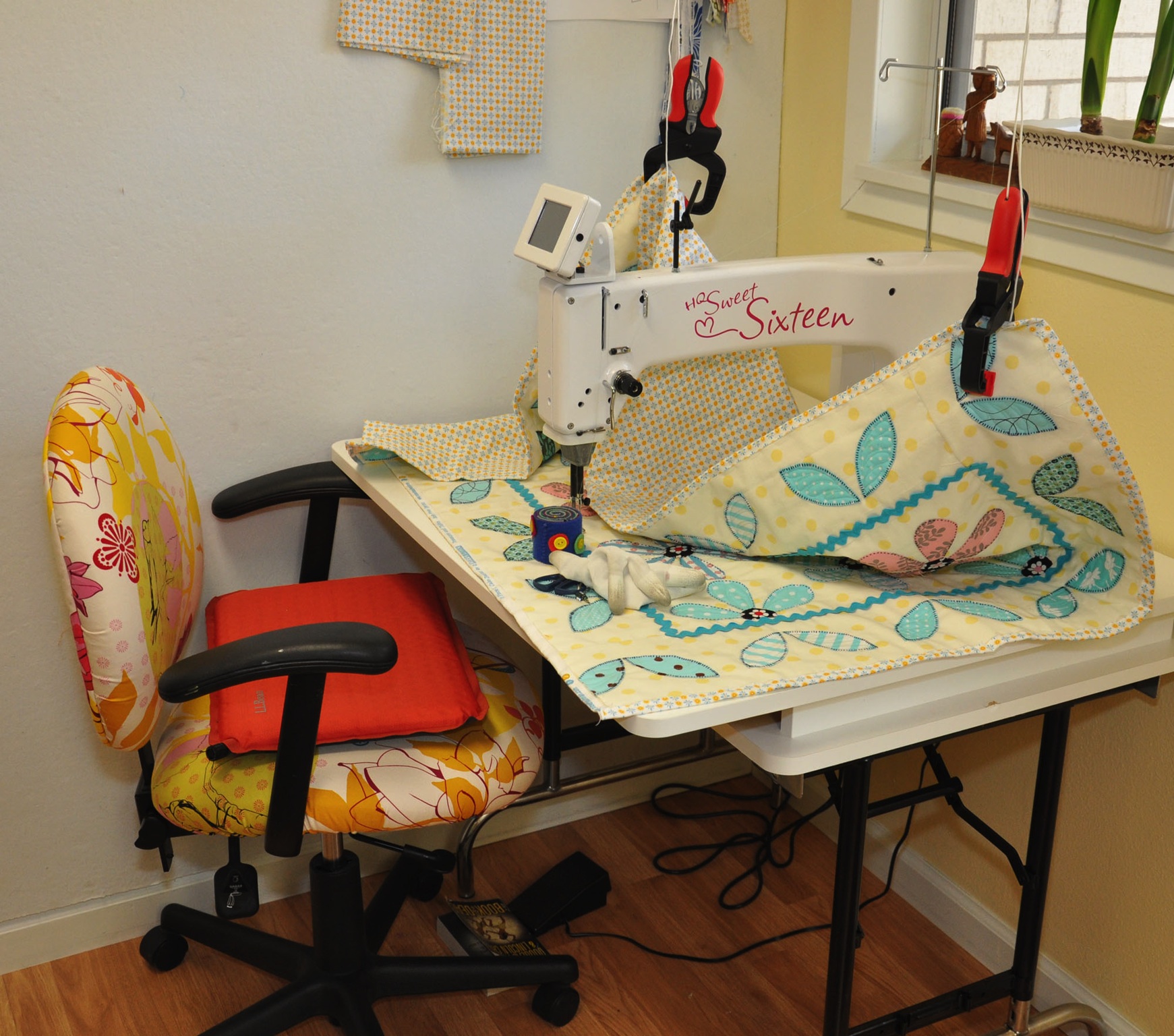
Steve installed my quilt-holding clamp system above the sweet sixteen. I’m working on my iPad and it’s hard to go back and find my original posts about this system. Basically I’ve got an inexpensive quick-release clamp on nylon cord that runs through an eye-bolt in the ceiling. The cord runs through a toggle so that it’s easy to raise and lower the clamp. I only need two here.
The controls are simple. Really simple. It takes a little getting used to but I like it. I’m running at 50% speed. The needle can be set to stop up or down. It takes a little bit to get used to the speed (or lack thereof) at the beginning and ending of your stitching. I’m used to it now and like it.
There is no knee lift. In fact, the presser foot does not raise in the traditional way.
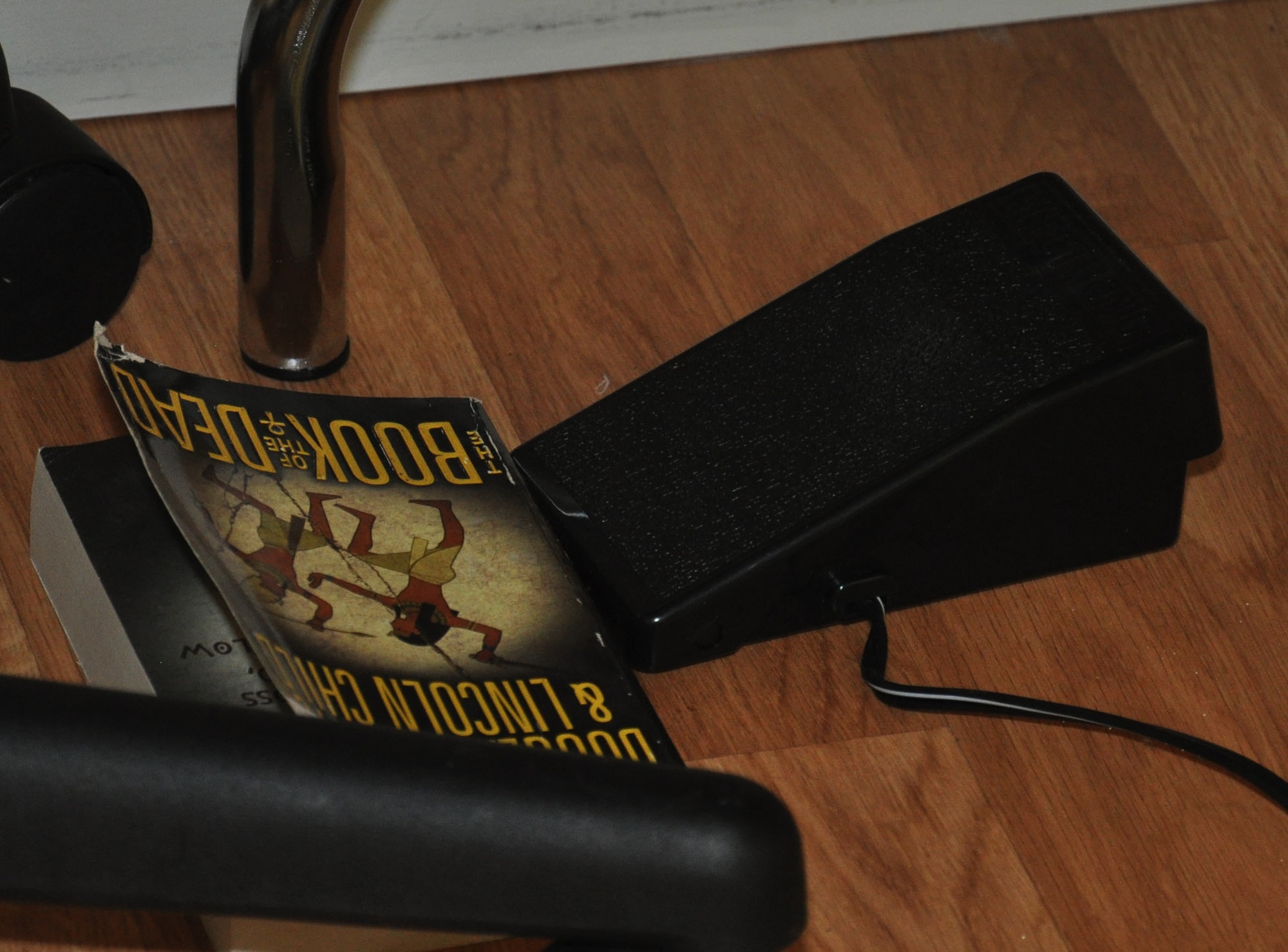
The foot control is very sensitive. And the slope seems high. I put a paperback book at the base of the foot control. I rest my heel on it and it has helped me control the stitching speed and my ankle is less stressed.
I like a lighter weight quilting thread and I have had the best luck sewing with Aurifill’s 50 weight thread. I haven’t used much else so can’t report on that.
Pay attention when you change needles. If you don’t put it in just right you will have problems. There is a trick to getting the needle straight and the person who trains you should show you how to do it well.
I hope this helps any of you who are considering this machine. As I said, I’m a fan.
I’m off to Canada in an hour. I go to the Royal City Quilt Guild in Guelph first and then on to the York Heritage Quilt Guild in Toronto. I’m teaching every day until I go on to Paris but I’ll do my best to blog on the road. Happy stitching!
Sent from my iPad

 Piece O Cake Blog
A few years ago, a friend’s chiropractor told her to turn her sewing machine foot around and under her chair. That way she can keep it close and use her heel to operate it. I have tried it and it does seem much more comfortable.
LikeLike
Now that is an intestine idea. I have not considered turning the foot around!
LikeLike
Autocorrect gives us such funny text!
LikeLike
Becky I have a 16 too – I had my husband add two wings to it with rounded corners to give me a lot more room for large quilts.
I’m curious where you’re adding oil – I didn’t see anything in the manual about where to add oil.
LikeLike
I purchased a Sweet 16 almost a year ago–I Love it! I now teach classes at my local quilt store. Let me address a few of your comments.
If you are not fortunate enough to have someone who will build a table for you, be sure to purchase the extensions. The corners are rounded and they are large enough that I do not experience problems with my quilt falling off the table top very often.
As for oiling, put one drop at the base of the bobbin case each time you clean your machine; clean your machine with each new bobbin. Start brushing at the top of your machine, be sure to clean the upper tension well and work your way all the way down to cleaning your bobbin case.
A TOWA bobbin gauge is Immensely helpful in obtaining perfect tension. The guide that comes with it says that all threads should run between 180-200, but I have not found that to be the case. Signature (40 weight) runs better at 200-210; Sulky (30 weight) should run at 150-160; and King Tut runs better at 300-310.
Once you have your bobbin tension, getting the top tension is easy. If you get loops on the top, your top tension is too tight. If you get loops on the back, your top tension is not tight enough. If your thread breaks, your tension is too tight; adjust your bobbin tension down and adjust your top tension accordingly.
The TOWA bobbin gauge is often listed on ebay; Superior Threads sells it online for $60.
Good luck and happy stitching.
LikeLike
Have been looking on line as to how you made the clamp system so you can lift your quilts up off the table. Can you explain about how you thread through the eye hook on the ceiling and through the clamp. Also how the the cord runs through the toggle. Could you post more pictures. I have just received my Sweet 16 and I just love it.
Thank you for you help
LikeLike
Do you like any of the Handi Quilter rulers? I have the versa tool but would like to know if anyone uses any of the others.
LikeLike
Hi Cyndi:
I havent used the rulers so cant say one way or the other how they work. You might try googling Sweet Sixteen (or Handiquilter) rulers to see if anyone has written reviews that would be helpful.
Happy stitching,
Becky
LikeLike