
I’m in NYC and just visited the Folk Art Museum where a wide variety of old and new quilts are on display. Loved seeing Paula Nadelstern‘s kaleidoscope quilt in the exhibit… I wanted to tell those around me that I know her and how wonderful she is, but I just smiled and kept that inside because it is a museum, after all 🤣.
I spent time with this quilt top by an unknown maker. I love both the structure and the freedom of the design. Notice the way the applique fills most blocks, going right up to the seam lines. There isn’t sashing and there doesn’t need to be. And the leaves and stems are cut from only two fabrics. I wonder if she ran out of one green and had to switch in the middle of making the quilt?
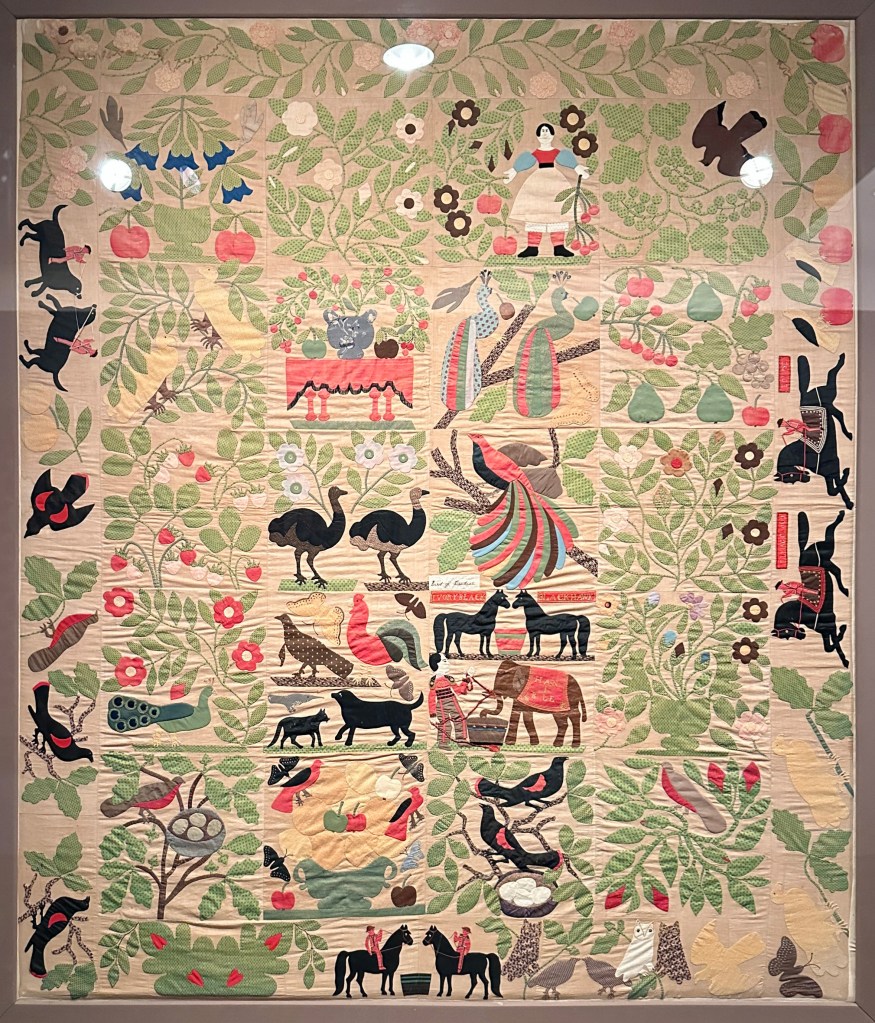
The applique stitches are invisible but if it were judged today, some might find faults…
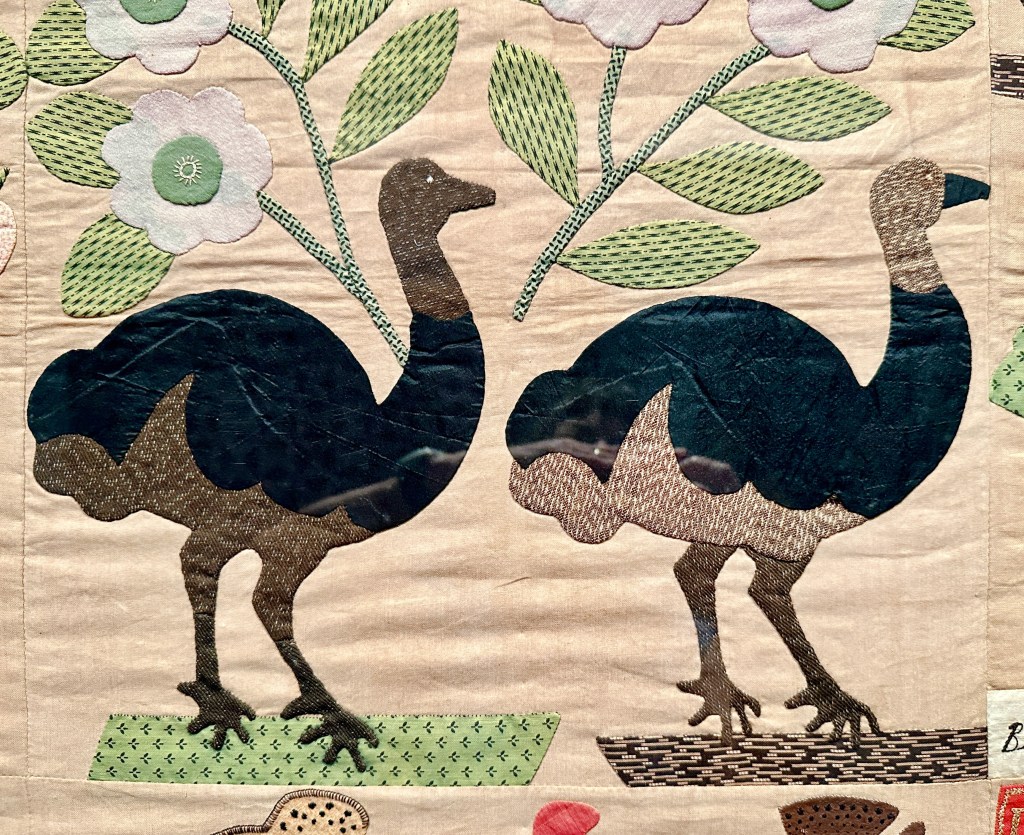
It is subtle, but you can see the vines and leaves shadowing through the white flowers, outer points on the ostriches are blunt. I like that the hand of the maker can be felt and I think she was enjoying her stitching.
Hanging next to the quilt were some of the original templates which I find to be illuminating.

First, she drew on printed paper that was probably not stiff. She did not require “special” paper. I will say right here that I am happy that I can use heavier paper and I like that I can cover it with peel and stick laminate 🤣.
Second, it looks like she she drew at least some of the shapes by hand and then cut them out. Notice how she adjusted the outer edges to make the shape easier to sew.
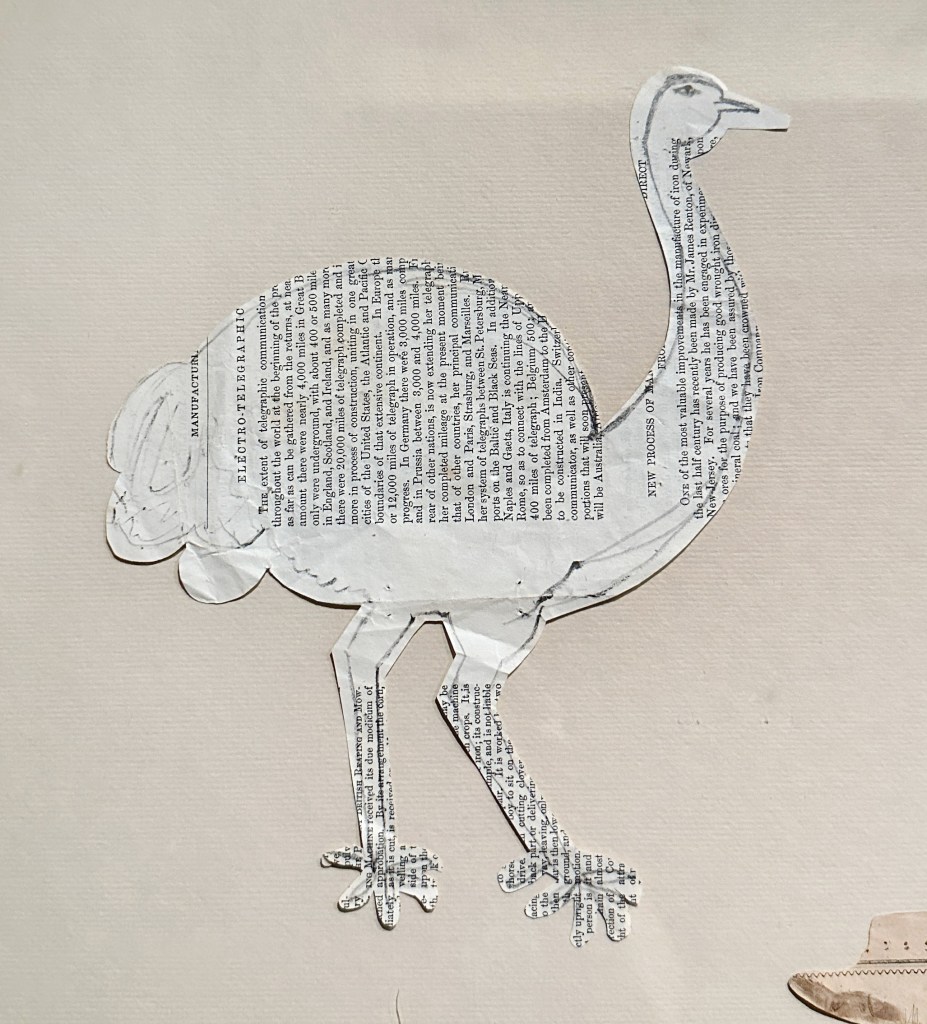
The beak is blunt on purpose and the funky toes on the feet of the ostrich are the way she intended them to be. Now look at the block again.
So what are the lessons this quilt teaches?
- One big lesson to be learned here is that we are way too judgmental of our own stitching.
- We might be too judgy when it comes to other peoples’ stitching as well.
- I am reminded once again there can be a lot of freedom in a design that has a tight structure.
- While I love working with lots and lots of different fabrics, it’s good to be reminded that you can do a lot with just a few.
I hope you enjoy this quilt as much as I do. Happy stitching!

 Piece O Cake Blog
wow… thats quite a quilt…. do you know what year it was done? I love it
LikeLiked by 1 person
I should have looked closer at the provenance 🙄. Somewhere in the later 1800s I think. If you are deeply curious, call the museum now (open Wed-Sunday) while the exhibit is there and ask. This quilt is very near the front entrance. Might be the 2nd on the right, or the 3rd quilt, as you walk in.
LikeLike
Thanks for replying..good idea to check with the museum….
LikeLike
It was made between 1858-1863 and thought to be an incompleted wedding quilt. The groom is missing from the quilt although he appears in one of the paper templates. Instead the block next to the woman is filled with flowers. It has been theorized that he died in the war.
LikeLiked by 1 person
Thank you, Jane, for filling in the details!
>
LikeLike
Oh my gosh as like you didn’t think I needed that but after I watched the video I guess I really do. Thanks for a great newsletter. My very favorite.
LikeLike
What a wonderful quilt! Thank you for sharing it. Reality check for the perfectionist in me as well !
LikeLike
Thank you for the picture of the quilt. I love her original work. I’m making a Baltimore from Ella Sienkiewicz s book,
Mary Ellen Tenney from Ohio .now in Georgia
LikeLike
Thank you for this. If I had seen this quilt in the museum I would have thought, “Huh. That’s an interesting quilt.” and moved on. Thanks for pointing out all of the details.
LikeLike
What a lovely quilt and a quite lovely (and loving) commentary on the quilt and appliqué. It is refreshing to be reminded that our previous quilting generation found “perfection” as challenging as this generation. Although, looking at the quilt and considering the tools the quilter had available, I think she certainly achieved perfection.
LikeLike
😍 I love it. It’s beautiful anyways.
LikeLike
Thank you so much. I have always found this quilt fascinating!! I actually made it myself through Suzy’s Quilt Shop BOM. Hand appliqué and hand quilted.
LikeLike
I did this quilt through Suzyâs.
LikeLike
If there is a link to the pattern, please share it. I’m curious :-).
LikeLike
https://threadbear.com.au/product/civil-war-bride/
It’s an Australian designer.
LikeLike
Thank you for the link! It looks like Corliss Searcey based her pattern on this quilt which is perfectly fine. My Bullseye quilt is based on a quilt from the Folk Art Museum as well. It is interesting to compare the two Civil War Bride quilts. Color choices make the differences stand out.
LikeLike
Yes, it is Corliss!
LikeLike
I Love this quilt! The lack of busy fabrics and multiple colors makes it very calming to me. It has a lot of action going, yet feels peaceful. Thanks for sharing.
LikeLike
Such a beautiful quilt. I always wonder where the fabrics came from and how long it took the maker to stitch. Love seeing the work of previous quilters.
Also, I do adore Paula’s quilts. I took a drafting course with her and found her to a fascinating person and wonderful quilter!
LikeLike
I just keep going back and looking at it-so wonderful,
LikeLike
This is very interesting. Thanks for sharing.
LikeLike
I enjoyed reading your professional observations.
LikeLike
T/y for sharing. I really appreciate your observations. It’s amazing what quilters resorted to using for their template materials as well as their fabrics. Seeing this quilt and others with a history keeps quilting alive and well.
LikeLike
Thank you so much for this post! I enjoyed reading your thoughts about this quilt and its maker. And, I learned a LOT from your professional critique of this simple but magnificent quilt. I adore the greens… and the thought that the quilter might have run out of fabric in the middle of it all and made do by using something that “worked” made me smile.
LikeLike
There’s another pattern adaptation for it, too. It’s in the book, A Bountiful Life by Karen Mowery, published by C&T. ISBN 978-1611690361
LikeLike
Who knew?! You can tell that this is not the kind of book I gravitate to 🤣. It’s an older book, so old it doesn’t show up on C&T’s site. If any of you reading this buy the old book used, be aware that often the pattern pages are not longer inside. It happens a lot.
LikeLike
Looks very useful
LikeLike
Fascinating! Thanks for sharing!
LikeLike
Loved seeing this quilt as well as the information as to how it was constructed. What a talented maker! Thanks for taking your time to include in your blog.
LikeLike
Loved reading this post. Thanks for the takeaway lessons. I’m keeping a copy in my quilt studio!
LikeLike
How wonderful! Thank you for the back notes; they made the lovely quilt become really alive. Thank you for sharing.
LikeLike
Love this quilt, too. And it’s “quirks” make it that much more attractive. Makes you wonder if the quilter made any more applique quilts.
LikeLike