Adding wheels…

I have a big, heavy, hard-to-move piece of furniture in my studio. When Miguel and Juan took out the floor after the flood, we put it on some flat things with rollers to make it easier to shift around. We left it on those things so that it would be easier to move around when the the new floor goes down. 

The 'things' made the piece of furniture taller and I realized that I liked it taller! Steve said he could add casters to my big piece of furniture. I found 175 lb locking casters – surely it's not heavier than that.


Wheels-01

Steve put a 2×4, laid flat, from front foot to back on the bottom of the legs on each side. He screwed the 2×4's on with long screws, and then screwed the casters to that.


Wheels-02

I may get around to painting the 2x4s, or not. For now I am just very happy that I can move this big thing on my own. I still have to fill it with stuff that is in boxes in the other room but I'll do that after they lay the new floor. That should happen on Monday. Maybe by the middle of next week we'll be back to where we were before the flood. 


Make an easy camera case…

It was time to replace my little Lumix camera. The new one came today and I realized that I had not ordered a case for it. The best place to look locally is Best Buy and you all know I'm not going there! I decided to make a case from one of my Piece O' Cake tote bags. I cut it apart at the edges, leaving the big middle to work from (I have a lot left over).


DSC_0033 copy

I measured my camera at and decided that a strip 4" x 12 1/2" would do it. But what if I was wrong? I decided to make a prototype from a Priority Mail padded envelope. I almost never take the time to do this but it's a really good thing to do.


DSC_0038 copy

I folded the strip over the camera to see where to place the bottom fold, leaving enough for the flap.

I sewed the strip right sides together with 1/4" seams, then turned it right sides out.


DSC_0040 copy

The flap was too wide and needed to be trimmed. I reinforced it with duct tape because I may keep this prototype in my luggage, just in case…


DSC_0043 copy

The case was just a little tight so I made the real one from a 4 1/4" wide strip.


DSC_0044 copy

The ends of the seams are backstitched, a lot. I folded the bottom corners and sewed across the corners to make gussets at the bottom fold.


DSC_0045 copy

Turning it right sides was sort of tough. I used that green stick that I've had for years to pop the corners out. then I trimmed the flap.


DSC_0046 copy

I decided to sew on velcro rather than using the sticky kind. Sewing it on the flap was easy – and then I realized that I should have sewn the other side on before sewing the case together. I had to unstitch some of one side to sew it on. If you make one, remember that part.


DSC_0047 copy

It's way cuter than the worn out pink one that was on my old phone. And it was free!


DSC_0050 copy

We're taking Jack and Elanor to Tanglewood today to swim and play and spend the night. It's a resort on Lake Texoma with a big pool and a nice restaurant. Maybe I'll get some good photos with the new camera :-).


Photos from a storm chaser…

I ran across this TED Talk. It is short, and beautiful. There have been so many devastating storms this spring and summer and I have watched the footage from storm chasers, transfixed. These photos are different and I think it's because they capture the beauty of the storms. That said, I don't think I'd want to watch any of them from where she is.


And, as long as I'm sharing short videos, here is one that my Aunt Helen sent to me. It is lovely but, if you have a dog nearby, let me know if they howl. There is a high pitch in there that sounds to me like it would make a dog bark.


Every now and then I am taken to task by a reader who says that I should write more about quilting. Unfortunately, I can't show what I'm working on because it's for a book that is too far from being in print. If I show too much now, it lessens the impact of the book when it comes out. I don't have time to work on quilts just for the blog, outside of the work I'm doing on the other projects. It's a real quandry.

Yesterday's post was an attempt to show something quilt-related, without showing too much. I'm going to try to do more of that. That said, I will continue to share things that are not specifically about quilting because inspiration can come from the strangest places… like TED talks and glass harpists :-).


A tape trick…

We've shown how to use tape when making triangle squares in a few of our books. This is a handy trick to keep in mind because it works for more than triangle squares. By using tape, you don't have to take the time to mark the seam line on your fabric.

The quilt I am working on is scrappy and the binding needs to be scrappy too. I prefer to make bias binding but in this case I decided to use many of the left-over strips from the quilt top. The strips are cut on the straight of grain, the ends of the strips are cut square. Binding looks better if the seams that join the strips are on the diagonal.

Here's the trick: Line the left edge of the tape up with the needle. Stick the tape to the bed of your machine and the table as shown below. Do not put the tape over the hole the needle goes into on the throat plate. If you have to cover a bit of the feed dog, that's OK. 


TapeTrick-Binding_001

Cross the ends of the strips, right sides together, as shown below. Three v's will form – place the two on either side of the crossed strips on the left edge of the tape.


TapeTrick-Binding_01

Begin sewing. Keep the v at the far end on the edge of the tape. Focus on it as you sew.


TapeTrick-Binding_02

Continue sewing across the crossed strips. Sew together as many strips as you need in this manner.


TapeTrick-Binding_03

Trim away the excess fabric leaving a 1/4" seam allowance. Trim any dog ears. Press the seams open.


TapeTrick-Binding_04

Cut one end of the binding off at a 45° angle. Press the length of binding in half, right sides together.

This combination of fabrics will make a nice binding for the quilt it's going on (look close and you can see a part of it in the background).

TapeTrick-Binding_05 copy


Back to the bathroom…

Chris and Steve worked all last week on the bathroom. I have to say that for a project that I came up with, I have done very little actual work. This bathroom is the handiwork of the two guys – and they have done, and are doing, a marvelous job!


P1010929 copy

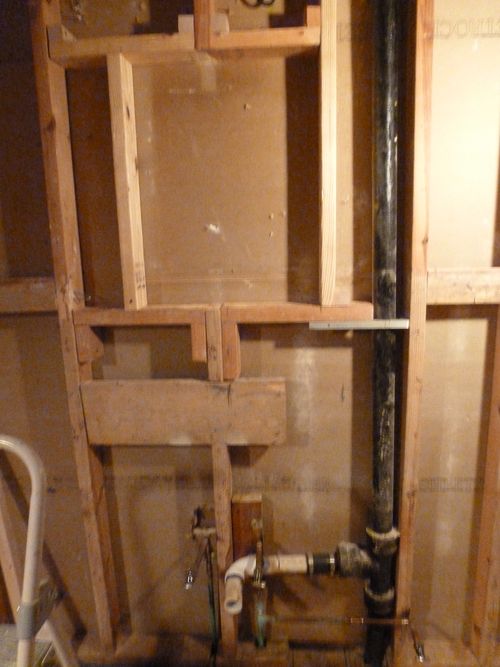
Once the plywood floor was in, they started on the walls. The space for the new medicine cabinet had to be framed in…

P1010936 copy

All of the electrical boxes had to be replaced, and moved. There was new wiring involved. We are going to have to have an electrician come out this week to deal with the old mess of wires in the attic. Neither Steve nor Chris likes the look of what's there.


P1010948 copy

They framed out the enclosure for the tub and put it in. This is a fiberglass tub and surround unit that has a nice, solid feel. It's going to be easy to maintain. They got this far and remembered that they needed to put insulation in the walls. They took it out, added insulation, and went from there.


P1010937 copy

They put in a SolaTube. We have 3 in our house and love them. This bathroom is in the middle of Chris and Lorna's house and it has forever been too dark. Not anymore! Here is the room, lit by the sun…


P1010946 copy

After installing the faucet and shower head in the tub and shower, they put up sheetrock.


P1010955 copy

Chris tiled the floor. I did help a little with this part. The tiles needed to be cut precisely at the edge of the tub. Our tile cutter couldn't do it so I took them to Lowe's to have them cut. Did you know that they will cut tile? They will.

My job was to spread the mastic, then Chris laid the tile. It took less than an hour. This is the same tile that he put down in Elanor's smaller bathroom.


IMG_1383 copy

Chris grouted the tile Saturday.


IMG_1389

Chris is now on his way, with 3 other grad students, to Taos for a writing conference. Steve is back at work on the new towel closet. It used to open into the bathroom from behind the door, behind the shower. Now it's going to open into the hallway. He's also taping and bedding the sheetrock. In a day or two I will be painting. Maybe this project will be finished by the end of the week!


Changing the ballast…

On Thursday one of the fluorescent fixtures in my sutdio began to flicker. On Friday it was mostly dark except for when it flashed intermittently, like a camera flash. Very annoying.

IMG_1375 copy

What usually happens in this case is that we replace the fixture. We've always bought into the idea that changing the ballast in a fluorescent fixture was just too hard. Well, this fixture matches the other one in the room AND Steve was busy in Chris's bathroom. I knew I couldn't change the whole fixture on my own because it is too heavy and unwieldy. But maybe I could change the ballast… I turrned to Google and found the following video by Oscar Moreno. Oscar makes it look really easy…

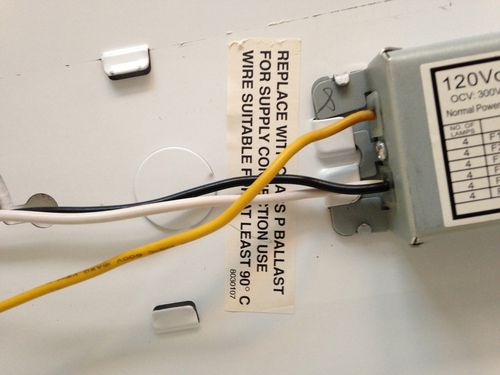
I did turn off the power to light at the breaker box. Didn't want to electrocute myself. I took off the plastic cover, then the bulbs, took off the cover to the ballast and wires. At one end there are 3 wires – black and white are power, the yellow is whatever it is. You can also see the slot at this end that the end of the ballast fits under.
IMG_1376 copy 

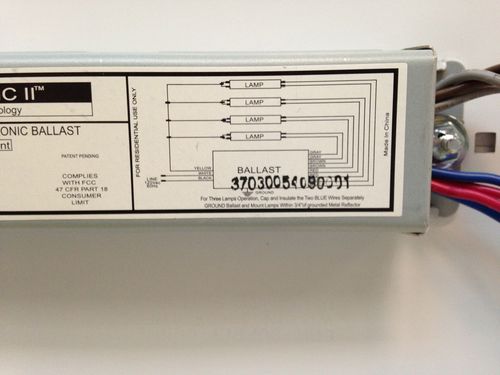
The other end of the ballast had more wires – red, blue, brown and gray. And a nut that holds the ballast in place. I cut the wires close to the end of the ballast, undid the nut, and took it to Lowe's to find a replacement.
IMG_1380 copy

The replacement ballasts were a different brand and they didn't have as many wires coming out. Very confusing. The very nice man (who tried not to be exasperated) explained to me that the number of wires didn't matter. He even took a fixture out of the box to show me what to attach where. I decided to trust him.

Once home, I put the new ballast in place and puzzled over how to make all the wires come together. My fixture had two wires in every place that there could have (should have?) been one wire. So I decided to join the one wire from the ballast to the two wires that matched up with the diagram on the ballast. If you look at the photo below I attached a blue from the ballast to the two blues on the fixture; then a blue from the ballast to the two reds on the fixture; etc. The yellows went together.

 
DSC_0001 copy

If you have not done this before you may not know that the wires are covered in plastic insulation. You have to carefully cut the plastic, but not the wire, and then pull the plastic off – exposing about 1/2" of wire. This is called stripping the wire. That was the hardest part. I did a couple but then Steve came home for lunch and stripped the rest for me.

I used the orange wire nuts to hold the wires together. They are simple yet effective. You stick the wires to be joined into the nut and twist. You can see the tools I used below/ That flat thing is a wire stripper that my dad made many, many years ago.  


DSC_0006 copy

Once the wiring was done I put it back together and reinserted the bulbs. I wasn't sure they would work, but they did! I switched on the breaker and there was light.

 
DSC_0004 copy

I saved some money by doing this, and time because changing the fixture takes longer than this did. I also kept the old fixture out of the landfill. I am inordianantly proud of myself :-). I also want to share the news that this is not a hard thing to do.