A pieced background…

The background in an applique block is the “negative space” that surrounds applique. You don’t want your negative space to overshadow the “positive space” – you want it to enhance the applique.

Our next book is titled Applique Outside the Lines. It’s all about constructing a quilt with freer lines. Imagine a line drawn with a soft pencil on paper, without a ruler. That line has a flowing quality that a ruler-straight line does not. We want to capture that flowing line in our quilts.

Most piecing is comprised of pieces that are cut with rulers. The sewn lines are very straight, very exact. Take away the ruler and you can cut flowing lines using a rotary cutter. The key is to not use a ruler. You’ll learn a whole lot more about this in the book when it comes out in July or August.

Linda and I put a lot of interesting backgrounds behind our applique – it’s part of the signature Piece O’ Cake look. In Applique Outside the Lines the backgrounds are scrappy and constructed without rulers. I’m constructing the backgrounds for my new quilt the same way. I’ll show you pictures of this block as it progresses over the next week or two.

Doug, the guerilla gardener…

My next door neighbor, Doug, told me last month that he is a guerilla gardener. We live in a cul-de-sac neighborbood. Much of it is surrounded by unkempt land. Tangles of vine and trees stand next to the alleyway drive. Doug decided to tame the wilderness and grow his surplus plants there.

He is making a lot of progress. Now, what I find to be the most amazing thing is that Doug has/had liver cancer. He was diagnosed 4-5 years ago and at that time the prognosis was not good. We don’t discuss his treatment, but he must be in remission – great news! In addition to clearing land and cutting down trash trees, he has spent much of the winter digging and preparing beds. He ordered a bunch of rare cannas that he planted a couple of weeks ago in his front yard. I’m looking forward to seeing them!

He’s had lots of little plants in all kinds of pots next to the alley. Every time I drive by I feel like a gardener who is just not keeping up. Lately his plants have been on the move. I have a feeling his yard is going to be more exciting than mine this year! But – I’m making quilts :-)!

More flowers…

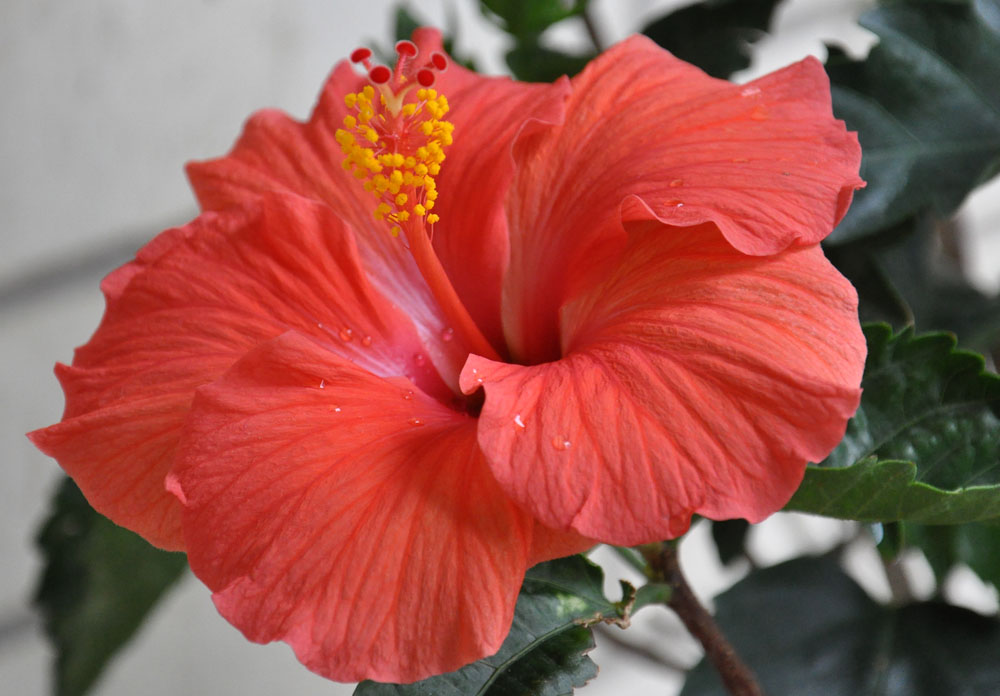
This is a red columbine. They are native to Texas and are very hardy. They go to seed but are not so prolific that they make me crazy. They pop up all over the place because, after I cut them back, the seeds drop as I carry them away. I could be more careful but I like the surprises.

It is still mostly spring here, although we had a freeze last weekend. I’m not complaining though. There are way too many people who are experiencing dire weather conditions. We covered our seedlings. The Texas bluebonnets don’t care if it freezes.

I don’t think the yellow columbine is native to Texas, but it likes my yard too. Columbines are sort of scary-looking, don’t you think? Scary, but lovely and graceful at the same time.

Washing Fabric – Part 2

Yesterday I wrote about why we pre-wash our quilt fabric. Today I’m going to show you how I do it. If you look at the photo from yesterday’s post, you’ll see a square gallon jug. That is a jug of Orvus Paste (aka Quilt Soap). It’s a sheep shampoo and I buy mine at Tractor Supply. I’ve used it for years and have been very happy with it. I found an informatinve article at Hart Cottage Quilts.

I use warm water. It doesn’t take much Orvus per washer load. I wet my hand in the washer water and dip it into the jar and scoop a bit out. In reading that article I find I should be wearing gloves. Oh well.

As the washer is filling, I grab my fabric with wet hands. It’s a real hassle to unfold fabric and get it in the washer with dry hands. Wet hands can grasp the fabric better and that saves a lot of time and energy. As my hands get dry, I stick them back in the washer water – with the lid up, my washer won’t agitate. NEVER stick you hands in a moving washer!!!! (See note below.)

Once the washer is done, I pull the fabric out of the washer and put it in the dryer. I cut the tangle of threads free from the fabric. I view this as a cost of doing business – it’s just part of the process. You could get creative and do something with these threads. I know I never will so I throw them away. I’ve tried all sorts of tricks to cut down on the threads and none have worked for me. I’m too lazy to serge or re-cut the edges with a wavy cutter. But that’s me – one of those tricks might work for you.

I dry on warm. Once the fabric is dry I pull it out and fold it. I don’t iron fabric until I’m ready to use it in a quilt.

Now – about that note… When my brother was 4 (I was 8), he had to have surgery. We lived in Oklahoma City and he went to Children’s Hospital there that is affiliated with the University of Oklahoma medical center. I’ll never forget my mom telling me about a much bigger kid (he was 18 I think) who was on the same floor with my brother. He had been doing laundry and he reached into a spinning washer to pull something out. Instead, he lost an arm and they were doing their best to re-attach it. I don’t think any washers then had the switch that is supposed to stop the spinning when the lid is up.

I decided to look to see if I could find a reference to this incident online and I didn’t find one – but I did find a link to this story dated March 25 of this year! It has happened again. And there are links to even more. So, let me stress this again – NEVER reach into a moving washing machine!

I really thought, until today, that all washers came with the safety switch that stopped all spinning when the lid was up. Be aware, as I am now, that they don’t all come with that safety feature.

Washing Fabric – Part 1

Linda and I always pre-wash our fabric – meaning that we wash it before we cut it up and use it in a quilt. Always. We wash in a washer and dry in a dryer.

I spend time in every class telling students why I wash my fabric and it seems like a good topic for the blog. So, why wash?

  1. Cotton shrinks when washed and dried. Not all cottons shrink at the same rate. For example, a batik shrinks less than most cotton off the bolt. If you construct a quilt with batiks and other fabrics, and then wash, your quilt can draw up in some areas and not in others. This often looks bad. You should also be aware that not all regular printed cottons shrink at the same rate either.
  2. Cotton can bleed. It is our experience that this is mostly due to water chemistry. Fabric washed in one place may bleed and it may not in other places. We think it’s much better to know if there’s a issue before you sew a problem fabric into your quilt. FYI – use Synthrapol, Retayne, or the Color Catchers made by Shout to control bleeding.
  3. In our opinion, pre-washed cotton behaves better. It tends to fray less because it has been pre-shrunk. It has a better hand. We have each used starch in the distant past but don’t any more because we haven’t noticed a need to use it.
  4. Pre-washing removes the chemicals and finishes from the fabric. Because I know quilters who can’t touch unwashed fabric, I asked my dermatologist about it. He said that, yes, these chemicals can cause problems for some people. He also said that some of these chemicals out-gas and that the fumes (that don’t bother most people) can be a problem. It’s also important to remember that most of our fabric is imported and that shipping containers are treated with insecticides and some of that residue could end up on your fabric.

So that answers the “why” question. Tomorrow I’ll answer the “how” question.

Becky’s new quilt…

We don’t often (or ever) post photos of our quilts in progress. It usually takes 1 year from the time we finish a quilt to the time when the book is at the quilt shop. It is frustrating to people to have to wait so long for a pattern. But blogs are all about sharing what’s going on now. So, while I can’t show you the whole quilt, I can show you selected parts of what I’m working on now.

I am using these pieces from Jinny Beyer’s Palette Collection. The greens laying on the diagonal are the block and border backgrounds. I’m piecing them. I’ll show you a pieced block background later next week.

Quilter’s often want to use exactly the fabrics that we used when they are making their quilts. This collection and these colors should still be available in 2 years – and even longer. Here’s a question for you: If I added a few prints or dots just for fun, and those fabrics were not available in 2 years, would you be unhappy? My thought is that there is always a fun substitute and finding those substitutes is a great way to make a quilt your own. Is that what you think too?

I really would like to know what you all think so please leave comments.