Magenta!

I subscribe to Now I Know, written by Dan Lewis. I get an interesting email about 5 days a week and on Feb. 4 I learned more about magenta.

Imgres.1

We all know that magenta fits in between red and blue, so why don't we see it in a rainbow? Now I know! 

The short story is that when visible light is broken down into colors (red, orange, yellow, green, blue, Indigo, and violet), red is at one end and violet is at the other. They don't connect so the blended color between them (magenta) isn't there. Click here to read the longer story.

Visible_spectrum

It's also interesting to note that magenta isn't on a standard, 12-wedge color wheel. Violet is what you will find next to red there too.  
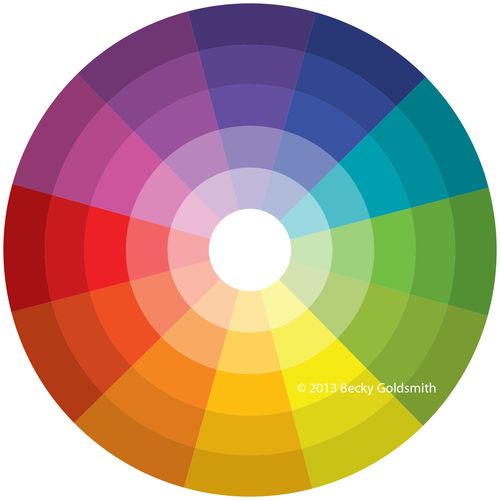
BeckysColorWheel

In related news, I only thought I was done with the manuscript for the Color book. My editor called Friday with several suggestions. After a deep sigh, I realized that her points were excellent and that the re-writing will make the book even better. So that's what I've been working on instead of blog posting. 

One of Lynn's suggestions was that I look again at Joen Wolfrom's Ultimate 3-In1 Color Tool. You know what? It's really very helpful! She includes a 24-part color wheel that includes magenta and more. Cool. But what's really nice about this tool is that it takes each of the 24 colors and shows them in a variety of tints (lighter versions), shades (darker versions), and tones (grayer versions).

It is the addition of tones that I think is the best part of this tool. If you work with grayed fabrics (like Civil War prints) this is really handy. For example, if you have a grayed red fabric and you want to put green with it, you can look at the greens and you will find a variety of grayed greens. Take the tool with you to the quilt shop and you can look for the best match to the color you want.

I've got the 3-In-1 Tool on order and will have it on the site soon.


The quilt pulley system…

I’ve written before about the system I use to help me manage the weight of a quilt as I machine quilt. I should have shown more details in that first post. I know that because I had requests for more information. Here is a more complete DIY guide.

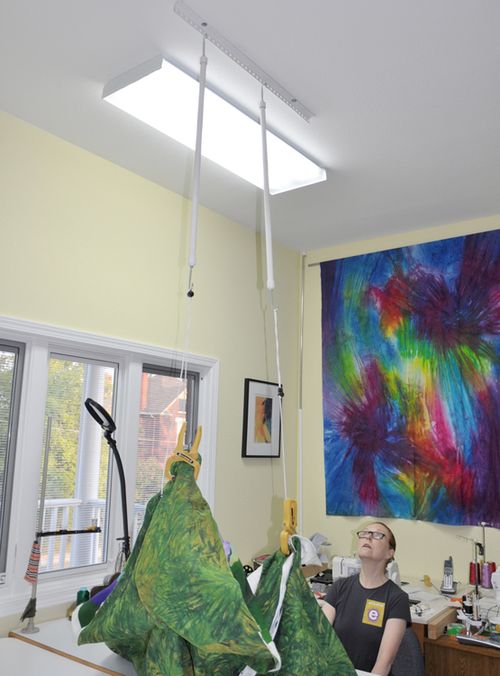
I first got the idea from Caryl Fallert-Gentry. Here she is at her machine:


QuiltPulley-01 copy

The idea is to use two quick-release clamps suspended from the ceiling to hold the weight of the quilt off of the table while you work. Her studio ceiling is very high so she added two metal poles with hooks on either end. I have 8′ ceilings so did not need the poles.

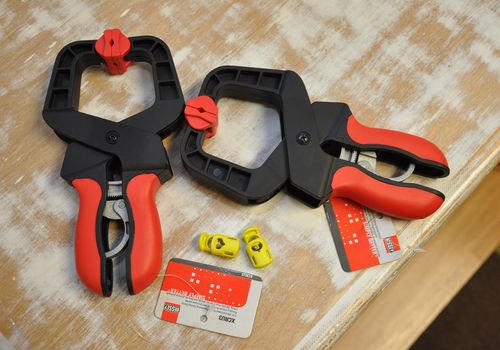
Here are the supplies you need:

  • 2 quick-release ratcheting clamps. Don’t get regular clamps with springs only—hey are hard on your hands.
  • 2 jacket-toggles—that’s what those yellow things are
  • Several yards of nylon cord—the kind you would use in a Roman shade (not shown) 
  • 2 big, eye-bolts for the ceiling (not shown). It’s a lot easier if you can screw them through the sheet rock, into wood. Otherwise you are going to need to look for something with a toggle.


QuiltPulley-02 copy

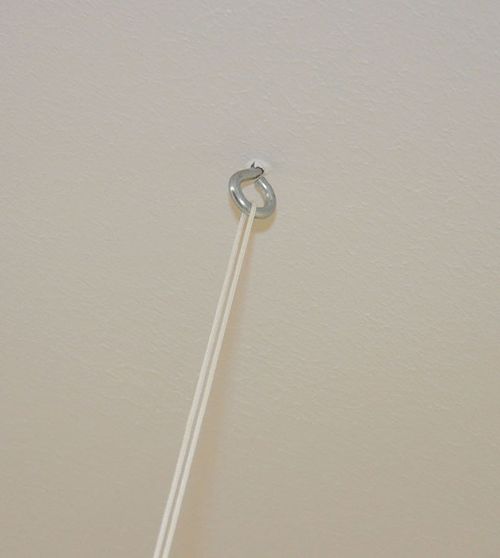
Here is what one eye-bolt looks like in my ceiling. This one measures about 7/8″ across.


QuiltPulley-05-750

I have a Sweet Sixteen. It sits in a table, front to back, not side-to-side like a home machine. My eye-bolts are positioned in the ceilling about 30″ apart, centered over the machine—one on one side, one on the other. They sit back from the front of the table about 12″.

If you machine quilt on a home machine, position one bolt (in the ceiling) behind the needle, about 12″. Position the other one 14″-16″ to the left of the needle (in the ceiling). 

Cut a length of nylon cord twice the length from your tabletop to the ceiling. That will be too long, but you can cut off the excess later.

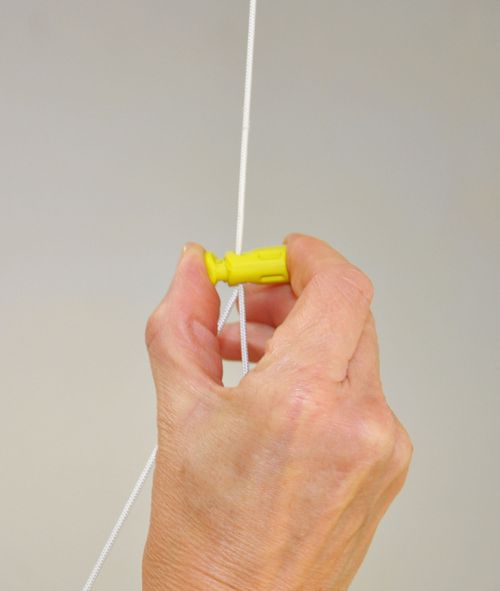
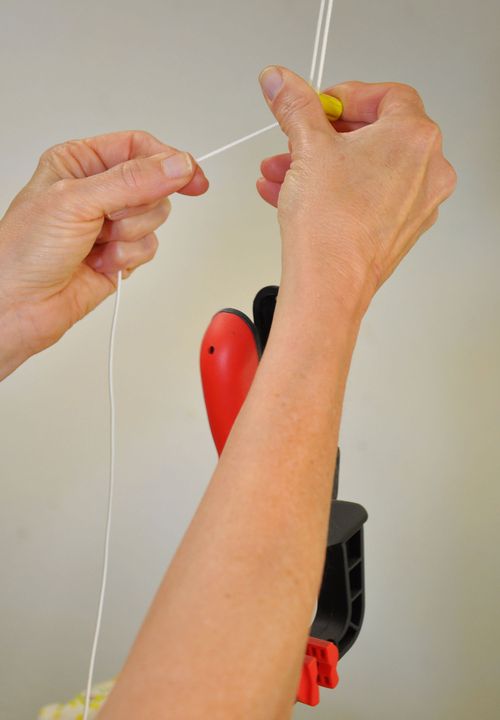
Squeeze a jacket toggle open and run one end of the nylon cord through it and then up through the eye-bolt in the ceiling. Run it back through the squeezed-open toggle.


QuiltPulley-06 copy

Tie one end of the nylon cord to one handle of a quick-release clamp. My clamps came with holes that were perfect for this. You might have to drill a hole.

To raise or lower the clamp, squeeze the toggle and pull the other end of the cord. As you use the clamps, you will figure out how much of the excess nylon cord you want to cut off. I like to be able to reach it from a sitting position.


QuiltPulley-09 copy

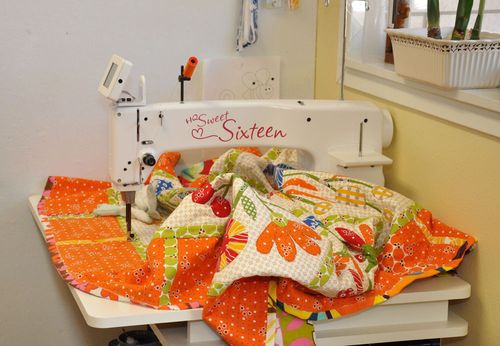
In the photo below I don’t have the clamps attached to the quilt. The weight of the quilt is on the table and hanging ove the edge. It is harder to manage.

SweetSixteen-01 copy

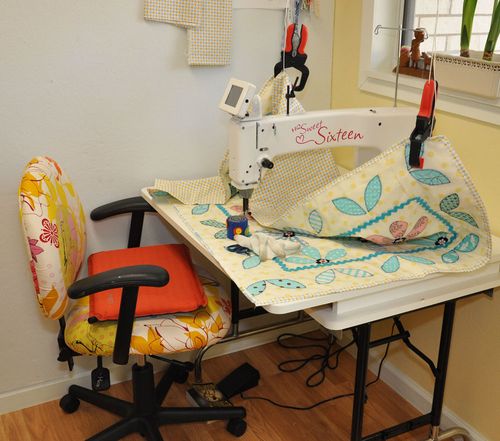
In the next photo I have portions of the quilt clamped and held up off the table. Somtimes my quilts look this tidy on the table but mostly they don’t. I don’t always clamp the outer edges of the quilt. On big quilts I have to clamp areas more in the center of the quilt.


SS-WithClamps copy

I change the position of the clamps often as I have to as I move and turn the quilt. It’s easy and fast. The more you work with them, the easier it is to know where best to clamp the quilt.

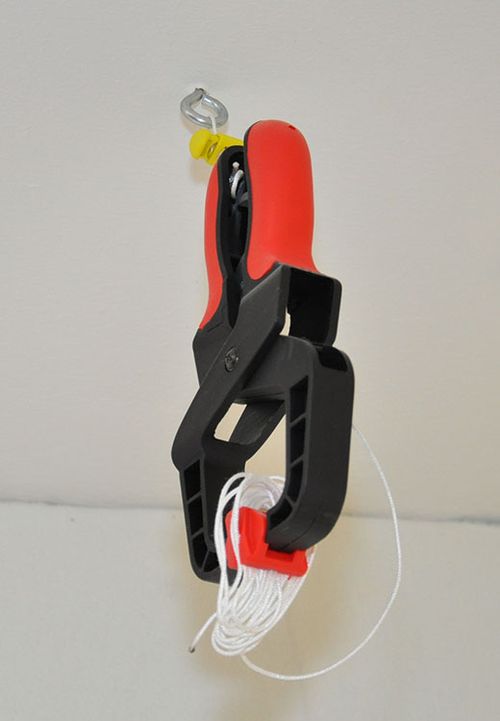
When I’m not using the clamps, I pull them up to the ceiling and clamp the coiled excess cord.


QuiltPulley-10-750

So there you have it! This is an inexpensive and simple way to control your quilt as you machine quilt. I hope you have as much success with this as I have!


Taking applique off the wall and making it portable…

I made a movie that shows how I take my blocks off of my design wall. I place the applique pieces on half of a folded sheet of paper (that has a smaller piece of flannel on it). the pieces are stacked so that piece #1 is on top and ready to sew. 


Once all the pieces are on the flannel, I fold the paper over them. I place the folded paper (with applique pieces) in a gallon-sized Ziplock bag. Usually the overlay will fit in the bag too. I carry my Frostings thread/bobbin sets, a pair of scissors, small pincushion, and toothpicks in a smaller baggie.

Enjoy the movie!