I got an email from Rebecca. After I replied I thought you all would enjoy both her email and my reply…

Hi, Becky!  I have both of your applique sampler books, have read them through several times, dog eared and highlighted, et cetera. I have also watched your videos.  You must be a wonderful teacher in person!  I’m working on my first needle turned applique block and all was going well until I got to the small leaves.  The block design is my own “Frankenstein” whig rose, combination of several different applique patterns from back issues of Quilter’s Newsletter, and I tried to include as many different shapes and sizes as I could so it would be a good learning piece.

I’m having trouble with the end where the leaf is round in a tight outer curve. I have been trying to finger press carefully along the chalk line, but I end up smearing the chalk and can’t seem to finger press a smooth enough curve exactly on the line—and my leaves are looking a little lumpy where they ought to look smooth. I have tried making my turning allowance narrower and turning only one stitch at a time.  Anyway, your other videos have been so helpful. I would love to see a tutorial on how to do a small, tight outer curve. Rebecca

I’m having trouble with the end where the leaf is round in a tight outer curve. I have been trying to finger press carefully along the chalk line, but I end up smearing the chalk and can’t seem to finger press a smooth enough curve exactly on the line—and my leaves are looking a little lumpy where they ought to look smooth. I have tried making my turning allowance narrower and turning only one stitch at a time.  Anyway, your other videos have been so helpful. I would love to see a tutorial on how to do a small, tight outer curve.

image

My reply:

Hi Rebecca:

Your stitching is lovely! Truth be told, you might be too critical of your own work. That said, if it was a circle instead of a leaf, more round would be better.
I wish I could do another video on tight curves and will but it’s going to be a while. I’ve got several weeks of work to do on the next book and barely have time to look up!

However, maybe I can help you with words, if not a video.

First, slow down on those curves. What I mean is that this area is not going to turn under particularly quickly.

Where you see the little bumps at the edge, I suspect that the fabric is pleated, or folded over itself, on the underside. When I sew a curve like that, I can feel the pleat with my fabric-holding-fingers as well as see it with my eyes. It is at that point that you should park your needle and use the point of a damp toothpick to reach underneath and smooth open the pleat.

Some pleats take more fooling with than others. That’s why you need to slow down and just work with it until the edge is smooth.

If your curve flattens out, use the point of the toothpick or needle to move it back into round.

Your stitches look pretty small (close together) but this is an area where you want to be sure that there don’t appear to be gaps between your stitches.

I hope this helps, both Rebecca and others who might be having trouble with curves!

Becky


Chirping pillows…

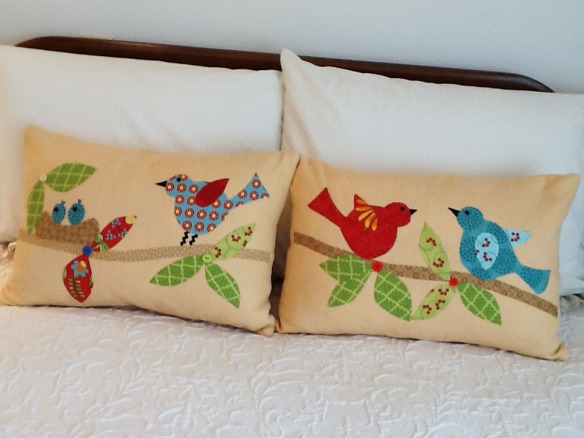
Susan (a blog reader) sent me this photo and I thought you all would enjoy seeing her first applique project!

SusansChirpPillows

Susan wrote: “I took parts of your blocks (from Applique With Attitude) and arranged them to suit the shapes of my pillows. I began quilting about a year and a half ago and came across your website quite by accident…..a lucky accident for me! I like applique better than any handwork I have ever done. Thank you for inspiring me…..wish I had your eye for color.

Your work is amazingly bright and beautiful and cheerful, and your website is so easy to navigate and packed with helpful information.  Your tutorials got me off to a good start for the basics of needle turn applique (I “cheat” and use a toothpick.) [FYI—as I wrote to Susan, toothpicks are a great tool and it’s not cheating to use them. It’s just smart :-).]

The buttons on my pillows came from my grandmother’s button boxes,which were an old snuff can and an old baking powder can.  She’s been gone for many years, but she is still with me.  🙂

Thank you for your long-distance help, Susan”

I have to say that I do enjoy getting emails like this. Seriously, who wouldn’t? I’m not saying that to get you all to write to me. No, it’s more of a reminder that we should all, me included, send notes of gratitude. That said, here’s one from me, to you:

Thank you all for taking the time to read what I post. Honestly, it makes my day to know that you all actually do that. I work from home most of the time and our online community is a very nice part of my life. I’ll do my best to not get boring :-).

Have a lovely day…

A wonky house show and tell…

house 15

Gail from Ontario sent me a photo of the little quilt she finished from a block started in my class at the London Friendship Quilter’s Guild in Sept 2013. She added some button flowers and embroidery and hand quilted the block into a little wall hanging. It’s way cute!

I am always happy to see the projects that you all make from our patterns. Happy stitching!

Seven Starry Sisters…

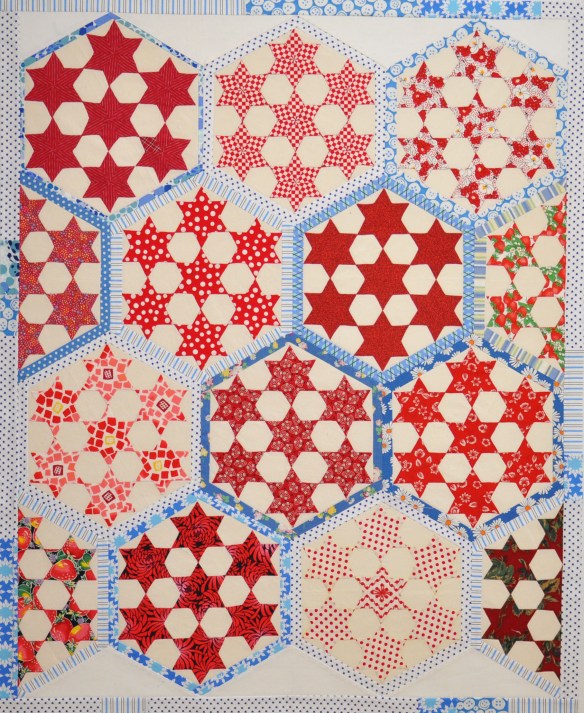
If you receive my newsletter, you have already seen this quilt and read at least part of the story behind it. (FYI: I posted the Seven Starry Sisters ePattern today.)

7Sisters-18

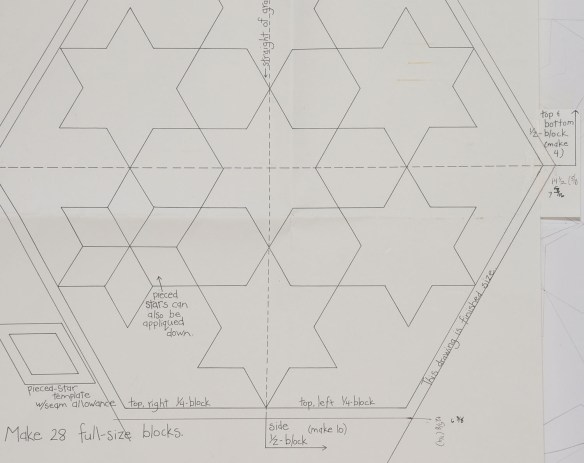
I started this quilt in the early days of Piece O’ Cake… back in the 1990s. In fact, it was so long ago that I drew the pattern by hand!

7Sis-Drawing

My Mom wanted to make a quilt and she offered to applique blocks. I gathered fabric, made the overlay and templates and she got started. And, as sometimes happens, years passed by :-). Every now and then she’d sew on the blocks and then move on to something else that interested her more.

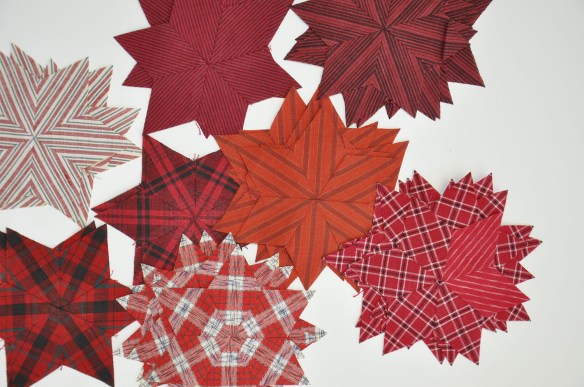
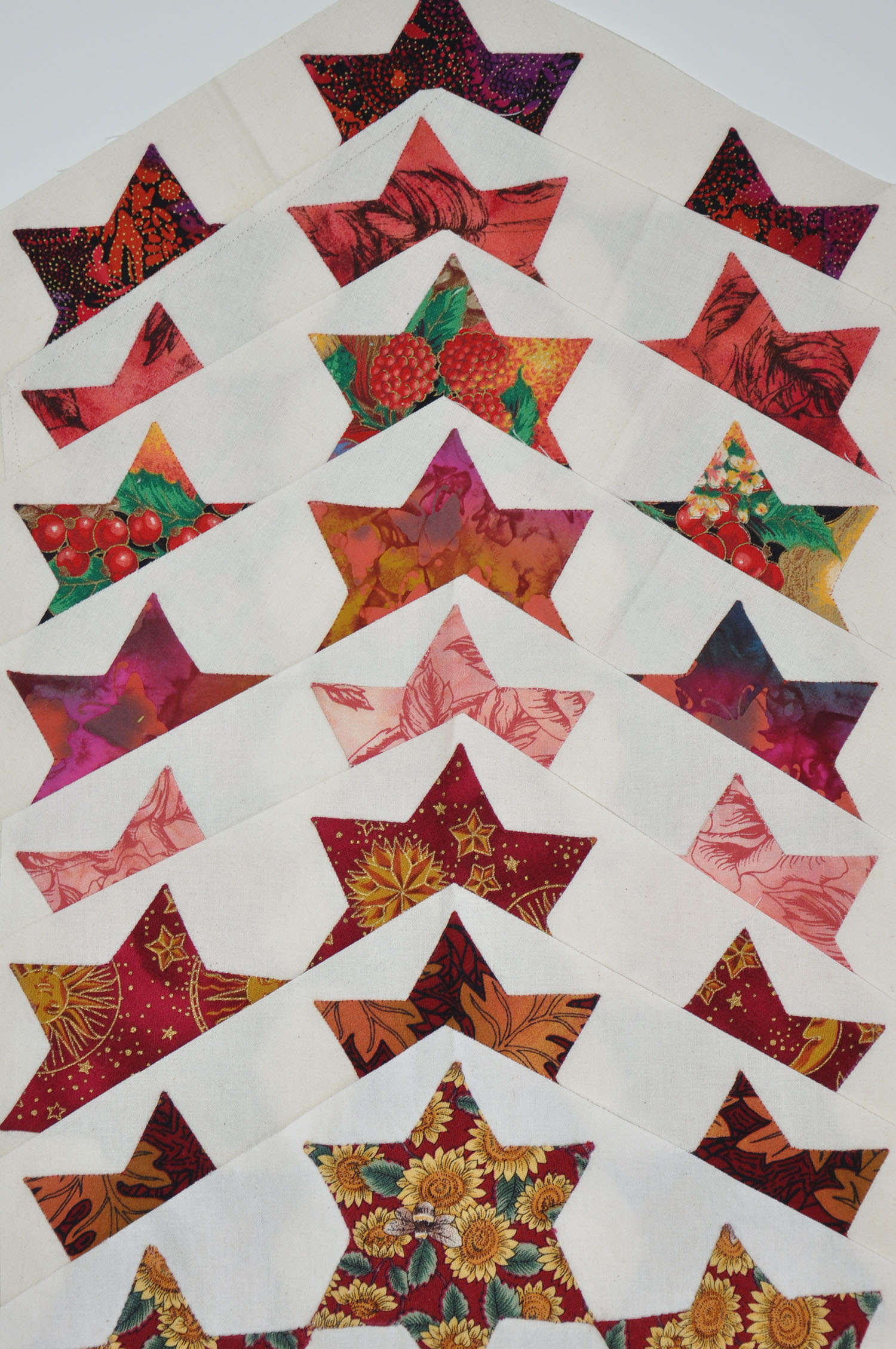
When Mom moved to Texas a few years ago, she gave me the blocks. Most of them were finished, but some were not. Interestingly, she hadn’t appliqued the pieced stars.

7Sis-PiecedStars

My tastes in color and fabric have changed over the years which is not at all surprising. I chose the clearest red and white blocks for the quilt I made and set these aside…

7Sis-QuietStars

And these two blocks have also been set aside. Honestly, I’m not sure what I was thinking when I chose these fabrics!

7Sis-BrightStars

The Seven Sisters is a traditional quilt pattern based on legends that relate to a distinctive star cluster, the Pleiades. The traditional quilt block can be pieced, although it’s a complicated block. There are probably English paper pieces that you can use to hand piece it. I have always thought that it is an easier block to applique.

I cut my blocks in a non-traditional way, with star points hitting the edges of the hexagon on all sides. I added sashing because these blocks were not all exactly the same size, but that turned out to be a blessing in disguise. The sashing adds a terrific spark of color and sets this quilt apart.

I’m sure that I chose blue for my sashing because I found the blocks on the 4th of July. But If I had run across them at Christmas, I might have used green sashing and this quilt would be different but still great fun. Click here if you’d like more info on the Downloadable ePattern.

And, in case you were wondering, Mom was very happy to see this quilt! In fact, the top is now in her living room, waiting for me to find a little time to get it quilted!

7Sisters-18


We’re in American Patchwork & Quilting!

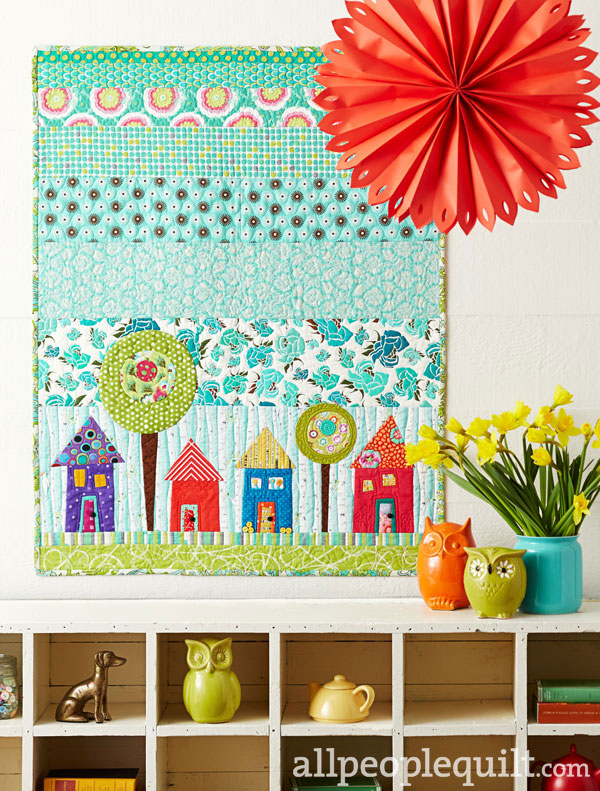
You are going to find a very cute Piece O’ Cake project in the June 2014 issue of American Patchwork & Quilting magazine! The June issue goes on sale April 1st, so you’ll be seeing it soon. This is the cover to look for:

Image

Please note that these images are used with permission from American Patchwork & Quilting® magazine. ©2014 Meredith Corporation. All rights reserved.

I drew the pattern; Linda chose the fabrics and made it so you have her to thank for the perky colors!

Image

This quilt makes me think of colorful little beach houses. It is happy and sunny! And AP&Q took amazing photos, as always :-).

American Patchwork and Quilting always makes up the projects in the magazine in more than one colorway. The alternate versions of this quilt are made from Benartex and Shannon fabrics. You’ll need to look at the magazine to see them… I haven’t even seen them yet!