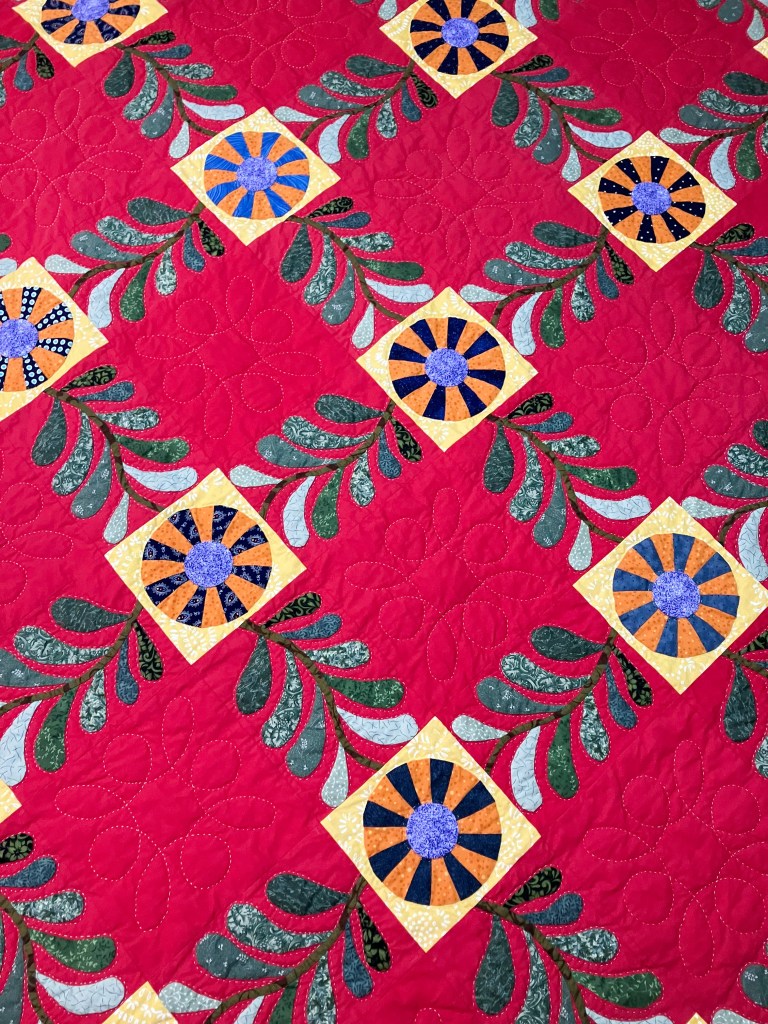
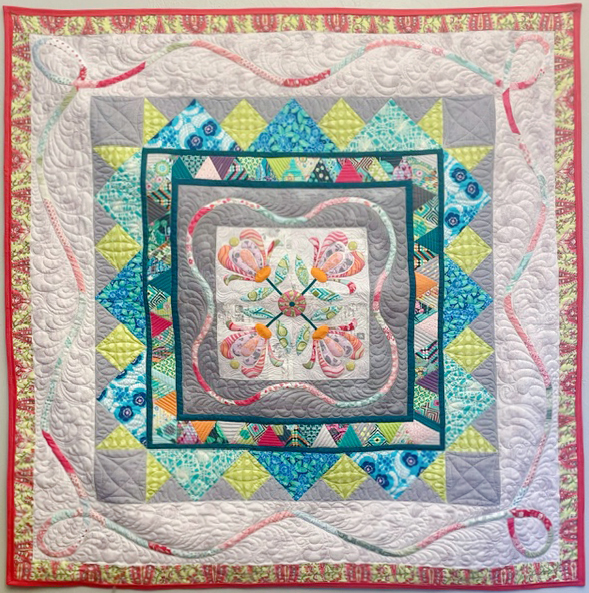
Julie Edwards sent me this photo of her newly finished, very pretty quilt that features a block from Aunt MIllie’s Garden as the center medallion.
Julie wrote:
This quilt was a round robin and completed by multiple people in 2015-2016. I belong to an online FB group, and we do swaps and other quilt alongs often. I completed the center block and then sent it to another quilter, she completed a border on that quilt, and off it went to someone else, etc. until it was completed and returned back to me. I finally quilted and finished it in January of this year.
Round robin quilts are always interesting and this one is no exception. The borders don’t overshadow the block at the center, the focal point of the quilt. Very nice!
Thank you, Julie, for sharing your quilt with us!.
Margaret Heller just finished her Simply Delicious quilt—it’s amazing!
From Margaret:
I followed the techniques taught in your books, except for the grapes and raspberries. For them I modified Karen Kay Buckley’s techniques for Perfect Ovals by laminating the front and back of the template (put the number of the template on the back side). Then I gathered the seam allowance of the grape or berry around the template, starched it/pressed it, and removed the template when it was time to sew it to the block .
I substituted blocks from the Beautiful Berries pattern for blocks from Simply Delicious so all the blocks illustrated my favorite fruits.
It was custom machine quilted by Christy Gray. (And she told me it’s the last custom quilting she will do.) I’m grateful that she quilted it for me; I doubt otherwise it would ever have been finished.
Thank you, Margaret, for sharing your lovely quilt with us all and I know you will enjoy seeing it hang in shows.
My quilts begin with an idea, then sketches. What you see below is the final sketch before I moved it to the computer.
This new quilt is going on my bed. Steve’s Birds, the current 2024 BOM, is for Steve’s bed. (Yes, we sleep in different rooms because—snoring 🤣. In our case, a good night’s sleep leads to a very happy marriage.)
The new BOM patterns will be available on their own, in January 2025. The downloadable patterns will not come with fabric—you can use any fabric that suits you. However, I am doing my best to make it easy for you to color your quilt like mine, if you want to.
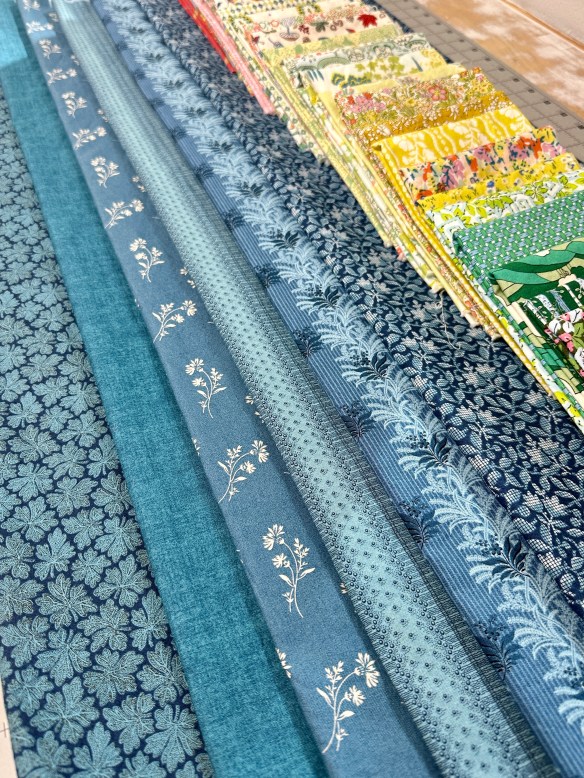
I am using medium blue backgrounds cut from a variety of Laundry Basket fabrics. This is what I have so far, there may be more. We will offer a kit with similar background fabrics, in a few months, for those who want it.
I am going to use many Liberty of London quilting weight cotton prints in my applique. The prints are iconic, the colors make me smile. I have started gathering fat quarters, but it takes time. You have to get the fabric when it is available and it sells out fast. Some fabric that we have on order won’t be released until next year. Patience is a hard virtue 🤣.
Knowing that some of you will also want to start building a palette of fabric, we are offering a Liberty Stash Building Club that will start soon. If you are interested, please get on the Waiting List. There are a limited number of slots and being on the Waiting List does not guarantee a spot—but you will get an email when it’s time to really sign up.
You don’t have to save this fabric for the 2025 BOM—you can use it for other projects. In fact, you will have Liberty left over after the BOM to use in other projects.
I need to start my quilt soon and will probably have to supplement with other fabric from my stash. Happily, Liberty plays well with other fabrics ☺️.
We love hearing from you when you let us know that you love something and also when you have an issue to resolve. Lee was the first to ask about this:
“I love my Lolo thread tamer, but I have a question. After several months of use – there’s a distinct thumbprint – it feels like the product is dry and a little gritty. Is it just time to replace it?”
Lorna talked to Kismet at LoLo who offered to replace the Thread Tamer but also suggested gently warming and stirring. Lorna relayed that info and here is what Lee did!
“So you can pass along to others, I ended up melting mine down on a candle warmer and adding some more extra-virgin olive oil. It’s worked perfectly since then.”
Thank you so much, Lee, for sharing! And it’s good to know how to keep LoLo’s Thread Tamer supple, no need to replace.
I did something similar to make a very small container of Thread Tamer to travel with. I carefully warmed up the original tin until I could scoop some out to put into a tiny little jar. That’s just one more idea to add in.
More about Thread Tamer from Marie: “I’m so glad I purchased Lolo thread tamer. Received today and immediatelytried it. What a difference as I’m sewing. Smooth, no tangles. I absolutely love it!!! Thank you for recommending a great product.”
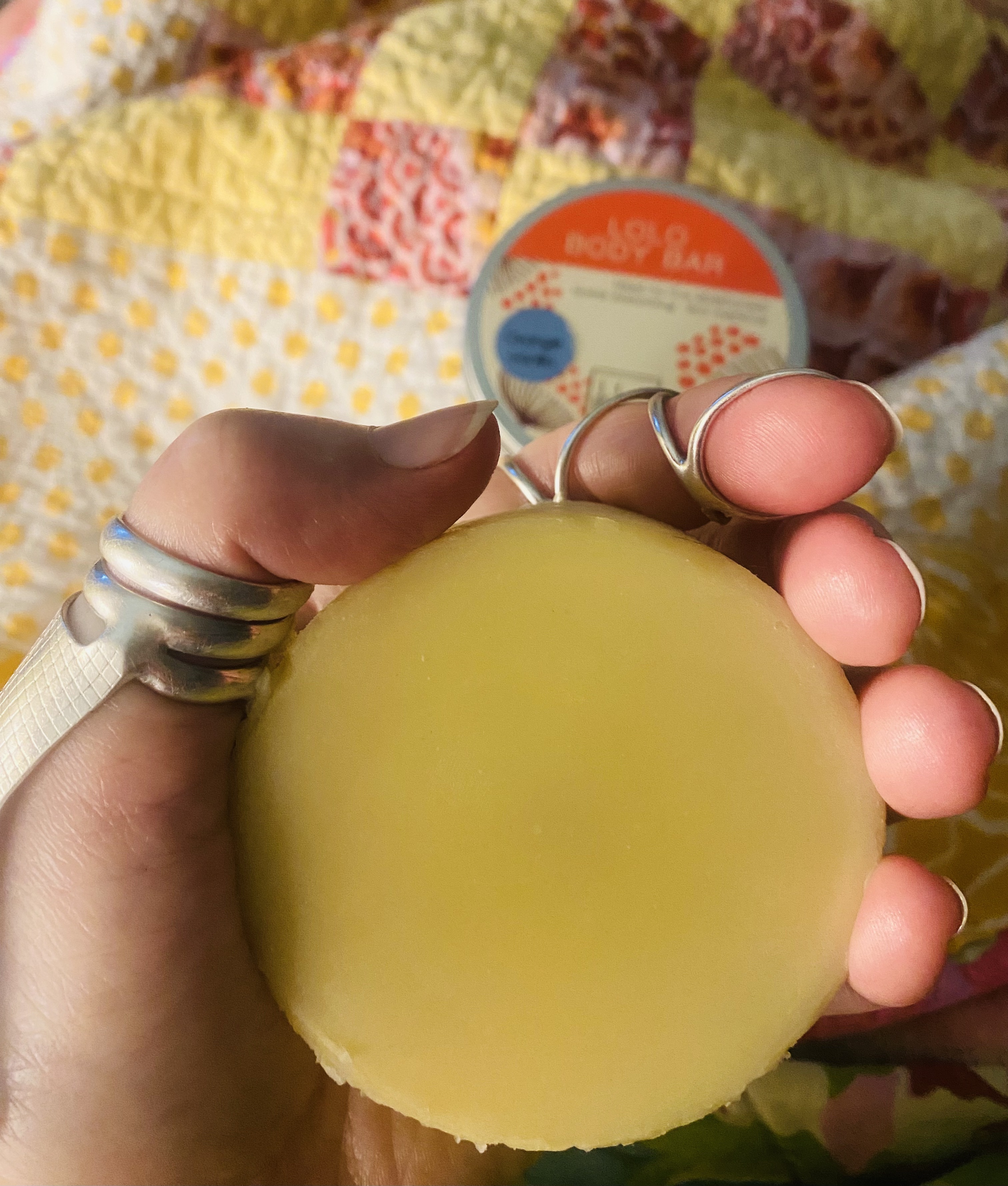
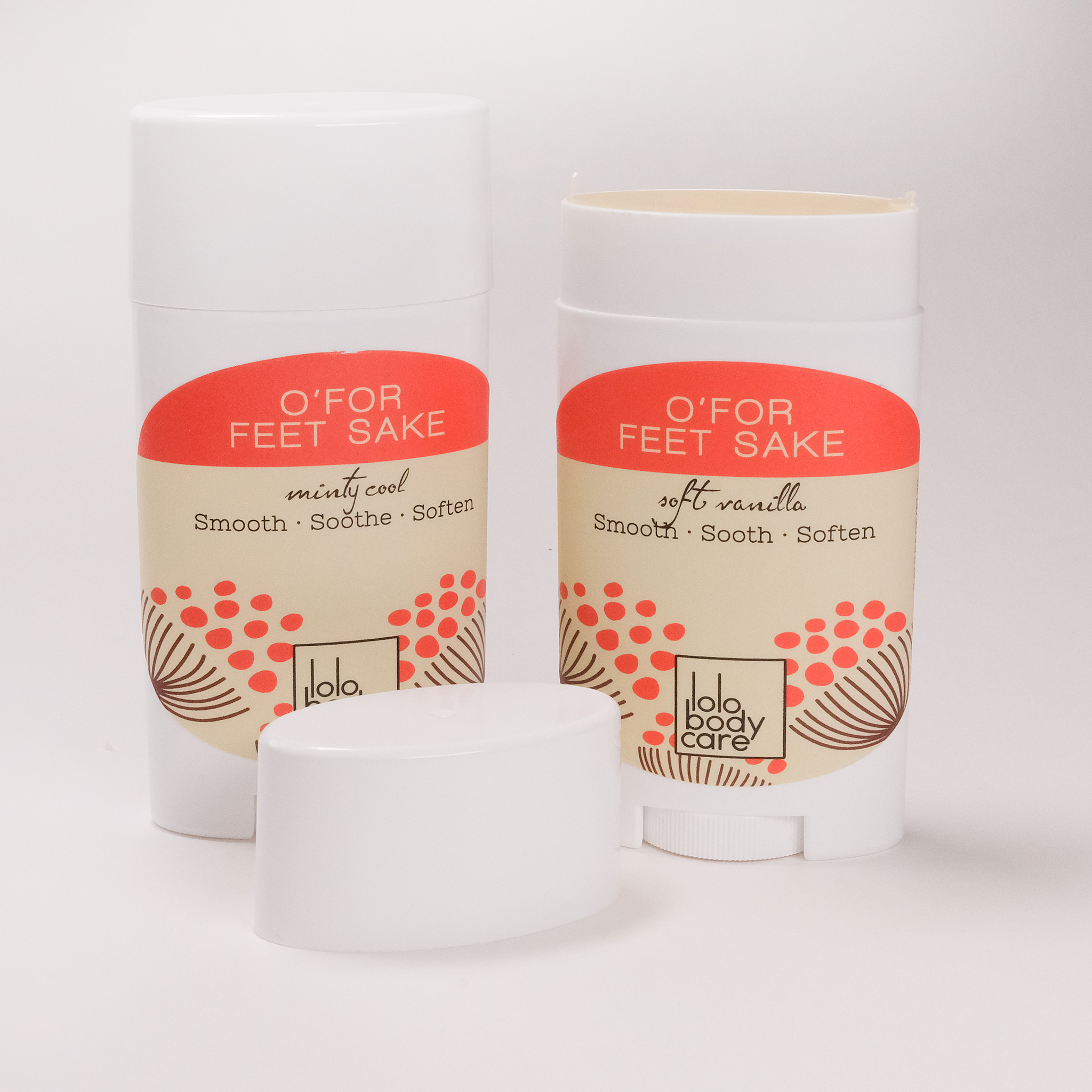
For your body, you will love LoLo Bars (a moisturizer in a convenient bar), Cuticle Intensives (love these miracle sticks!), Soaps, and LoLo Feet. But don’t just take my word for it…
From Cathy: “I ordered the LOLO bars and LOVE them. It works so well on my split finger tips, I can stitch!”
Cathy also said that it’s amazing how after applying, LoLo doesn’t rub off on the wool or the thread she’s working with. She went from needle-turn appliqué to wool because of eyesight problems. Wool appliqué is “so forgiving,” she says, enjoying her afternoon hand sewing ritual.
Hand sewing is a calming focus when the world might not be calm. I’ve enjoyed evening hand sewing for decades. It’s what we do.
Have you made one of these cute needle caddies yet? If not, you can find the FREE ePattern for the Big Needle Caddy at pieceocake.com, While you are there, you might be interested in the other FREE ePatterns. But you don’t have to make a needle caddy to be interested in knowing more about hand sewing needles.
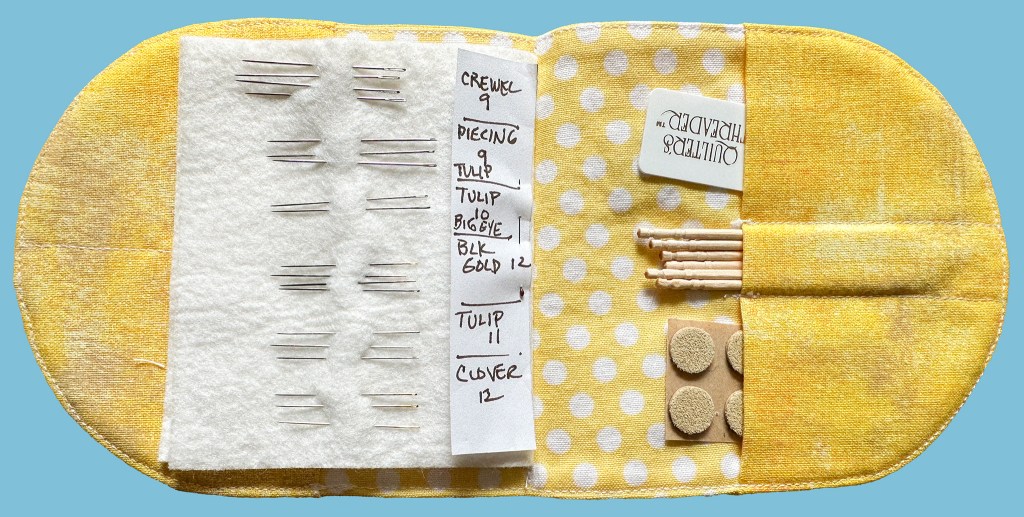
I am careful to pair a needle with the kind of sewing I am doing, and the thread that goes with it. Since I do a variety of kinds of stitching, I like to have a variety of needles to choose from with me when sitting down to sew. This is how I filled my own needle caddy.
First, you need to identify each needle so that when you need more, you know which package to choose. Cut a strip of paper to write the needle particulars on, grab a pen or pencil, and gather your needles. Which needles, you ask? Why… these needles!
#9 Crewel Needle by Bohin: This is a very versatile needle with a long eye and strong body. Use it with wool thread, perle cotton, and 30-40 wt cotton thread. Great for embroidery, big stitch hand quilting, and some hand sewing.
#9 Piecing Needle by Tulip: An all-purpose needle good for a variety of hand sewing jobs, especially hand piecing. This needle is a little long, with a sturdy shaft. If you have trouble handling smaller needles, this and the crewel needle above might be good choices.
The next four needles will work better with fine thread like Superior’s 50wt/2-ply thread that only comes on prewound bobbins. Presencia’s 60wt/2-ply thread, Aurifil’s 80wt, and Aurifil’s 50wt/2-ply thread are also good choices with these needles.
#10 Big Eye Appliqué Needle by Tulip: Tulip applique needles are smaller and finer than their size number would indicate. The big eye on this needle makes it easier to thread. It is longer than #11, but not as long as a milliner’s needle.
#12 Black Gold Appliqué Needle by Clover: This needle is tempered and honed to a very sharp point. It is rigid, not bendy. I get a very nice, small stitch with this needle.
#11 Appliqué Needle by Tulip: Very much like the previous needle, but this one is more flexible. I use them interchangeably except that sometimes my fingers have a preference. I don’t know why, but that’s true.
Note that when the package says “appliqué” needle, it is often a sharp. A sharp is a needle most often associated with hand sewing. It could also be a longer milliner’s needle which is associated with hat making. Look close and the package will probably tell you which it is.
One of the best features of this needle caddy are the little pockets, shown in the photo above. Mine pockets hold round wooden toothpicks, Leather ThimblePads, and 1-2 flat needle threaders like Roxane’s RX Needle Threaders.
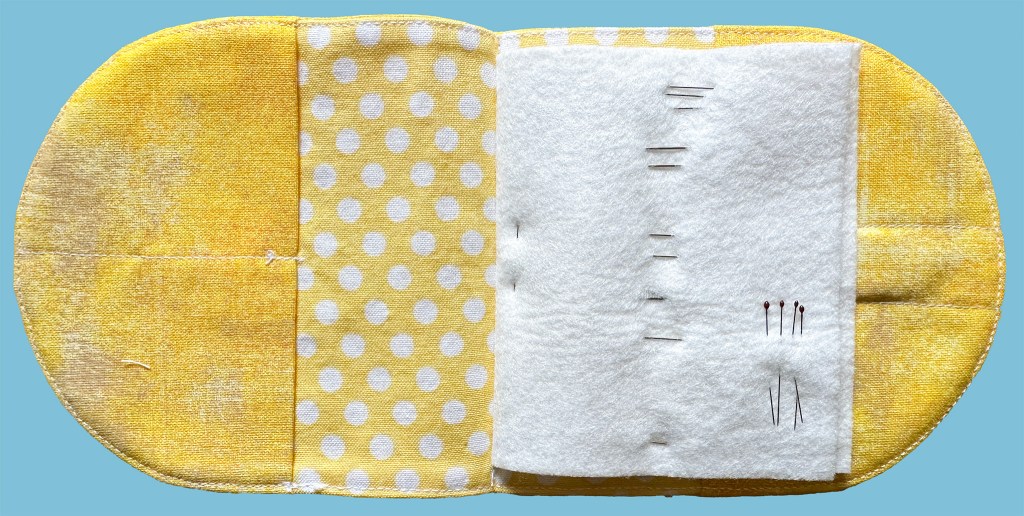
Each caddy has two bamboo felt “pages”. My 2nd page holds needles I use less often. Any of the first three listed below would be good with strands of embroidery floss.
#24 Chenille Needle by John James (JJ): Chenille needles, with their big eyes, are designed to carry thick thread. They can get clunky but this one is finer than most. Good for a #8 or #12 perle cotton.
#12 Black Gold Between by Clover: Use this needle for finer hand quilting. It is sharp, very short, and used for fine hand quilting thread.
These are applique needles that I sometimes use:
#11 SuperGlide by Colonial: I almost never use this needle. It’s bigger than my preferred appliqué needles, but not as big as the #9 piecing. It is easy to thread!
#12 Appliqué Needle by Mary Arden: This is an excellent, inexpensive needle. The eye is kind of big which is not a bad thing. The needle is a good size, fine, and sharp.
There are two more little inside pockets inside the back page on the other side. I will add a Domed Under Thimble with adhesive pads in one of them.
Click the names of individual needles above to find them on my site or go to Everything In My Needle Caddy, to find them all.