Kauai Road…

Having the line drawing of the palm trees and telephone poles helps a lot. All through this process, I could see how they would fill up the foreground. The sky, mountains, and bushes on the sides of the road are really background.

Once the mountains were in place, I went back to the road and began cutting fabric for the bushes and trees, but it was slow going. I then turned my attention to the sky, which is mostly cloudy. (It is, in fact, very often cloudy in this spot on Kauai.)

Kauai Road 5

Finding the right fabrics for the sky was hard!!!—so I went back to the greenery :-).
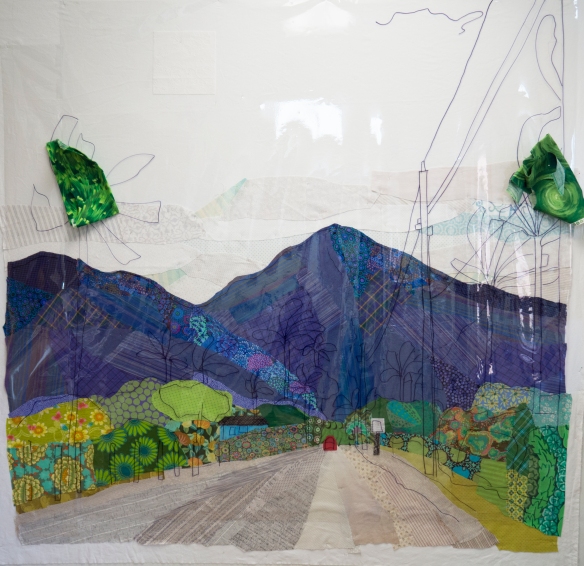
Kauai Road 6

There is a car in my photo, but it’s isn’t red. It needs to be red!

OLYMPUS DIGITAL CAMERA

After getting a lot of the foreground trees and poles cut, I went back to the sky. It was still hard, but I stuck with it. I did have to go buy some fat quarters which was a surprise. It’s getting closer to being ready to take off the wall!


Kauai Road, continued…

Kauai Road

Working with only a rough sketch and no pattern shapes is very different for me. In my applique life, I have drawn patterns that many of you have sewn. The pieces are specific, and numbered. You trace around the templates to make a shape that fits the pattern.

I have also worked in the manner of Ruth McDowell, where I started with a photo and generated a pattern on freezer paper. In this kind of quilt, you may hunt for the right fabric for a shape, but you have a pattern for that shape.

CoffeeCup

As I work on Kauai Road, I’m thinking about so many things at once: What color do I need? What fabric do I have? What size or shape should each piece be? And on and on…A person can only make so many decisions before her brain has had enough. Even though this is fun, it’s a challenge. So why am I working this way?

I want to construct Kauai Road more in the manner of Edrica Huws. I have mentioned her work before, on this blog post. There’s not much documentation on her sewing methods, but in looking at her work I surmised that she was not strictly bound by a drawing, and that she cut shapes more or less intuitively, by hand, with scissors.

OLYMPUS DIGITAL CAMERA

I am learning new things as I work this way, and it’s invigorating!

Figuring it out…

When designing a quilt from a photo, you have to figure out where to start. I opened my photo in Photoshop and cropped in to focus attention on the part of the photo that I liked best.

KauaiRoad-01-Cropped

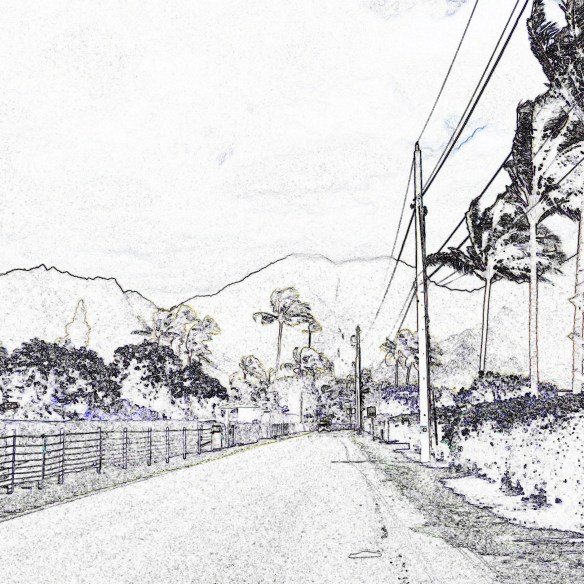
I usually work in Adobe Illustrator where I can make layers and trace over a photo to make a pattern. But there’s a cool filter in Photoshop called Find Edges. I used it to generate this almost-drawing:

KauaiRoad-01-Edges

I am not going to fuse or glue this quilt. The pieces will be pinned, then basted on a light fabric base. I projected the image onto a 60″ x 60″ piece of thin, prewashed, white muslin on my design wall. I used a soft pencil to draw a stylized version of the image onto the fabric.

I decided to work loosely, cutting fabric to fill in the different areas without making templates or pattern pieces. It didn’t take long for me to realize that the drawing needed to be on an overlay so that I could still see it as I added fabric to the wall. I cut a great big piece of upholstery vinyl, pinned it over the muslin, and traced the lines with a regular Sharpie marker—the kind that comes to a blunt point.

OLYMPUS DIGITAL CAMERA

I’m not aiming for photo realism here. Instead, I’m working in a looser, slightly more impressionistic fashion. It is both scary and fun!

Day to night…

I just watched Stephen Wilkes’ TED Talk. He is a photographer with a vision—and some exceptionally cool equipment.

My Photo Class assignment for the week is ‘stuck in place.’ We have to pick a spot and stay in it for an hour, taking pictures. I had the same assignment last year and really enjoyed it. I’m glad to have seen this video before I set out with my camera :-).

More about that bird…

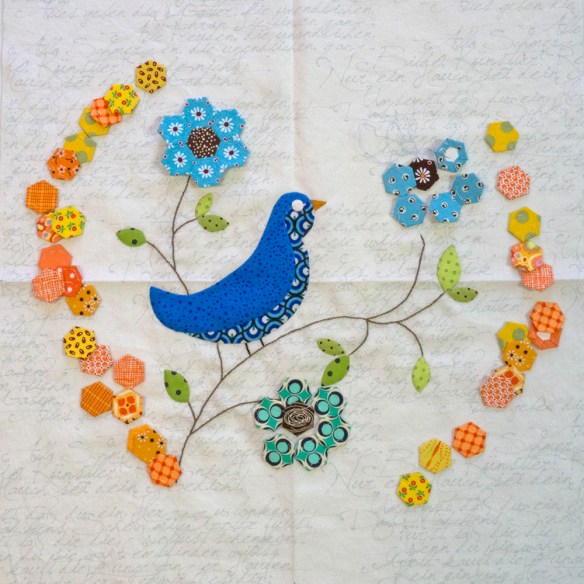
If you get my newsletter you will have seen the Hexy Bird block I’m working on now. I still have to add a pupil to the eye, stitch the blue hexies into flowers, and stitch the yellow and orange hexies together to make the larger hex that surrounds the bird—and then applique them to the block—but you can see where it’s going. I think this will be the center of a terrific baby quilt!

Below is Linda’s Hexy Bird, which is also very cute. Isn’t it surprising to see how different a block can look in a different colorway?!

Hexy Bird Block

It may be a while before I have borders around my block, but when I get it together, I’ll share the photo. Click to see the Hexy Bird ePattern if you missed it when I showed it before.

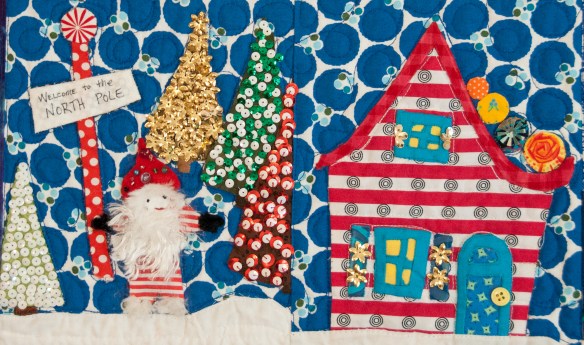
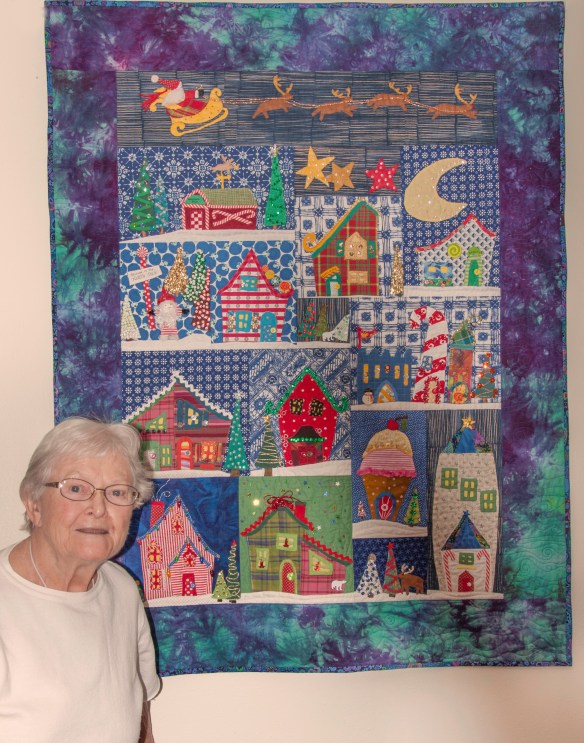
Show and tell… my Mom’s Welcome to the North Pole!

My mom began this quilt in May of 2012. The finished quilt went on her wall a couple of weeks ago…

MomsNorthPole-13

Mom chose some fabric from my stash and then I brought more fabric. I offered to give her ‘help’ but she was very happy do make this on her own. She did it her way and it’s perfect!

The top was finished in time for it to hang on her wall last year, un-embellished. I quilted it this summer and she spent the following weeks adding embellishments. Can you tell that my mom really likes sequins :-)?

MomsNorthPole-26

None of this was easy for her. She struggled with her glasses, arthritis and neuropathy in her fingers. Threading the needle and dealing with the little sequins and beads was a challenge—but she did it! Click the arrows on the slideshow, below, to see more of the blocks.

This slideshow requires JavaScript.

Have I said that I’m proud of my mom for sticking with this? I am! It has a folk art vibe that just can’t be beat. Way to go, Mom!